Automation & CRM for Hospitality, Food & Drink — The Practitioner’s Playbook.
A focused playbook for Hospitality, Food & Drink operators running Automation & CRM. Static PDF menus, broken booking widgets and zero structured data are still the default in hospitality — and the result is leaked "near me" search every weekend. Private hire, corporate and group bookings are the highest-margin lines but the most under-served by typical marketing.
Automation & CRM for Hospitality, Food & Drink is its own discipline.
Six things this playbook covers, end to end.
Pipeline architecture with stages, criteria and owners
Tuned to Hospitality, Food & Drink — the version we ship to operators in this vertical.
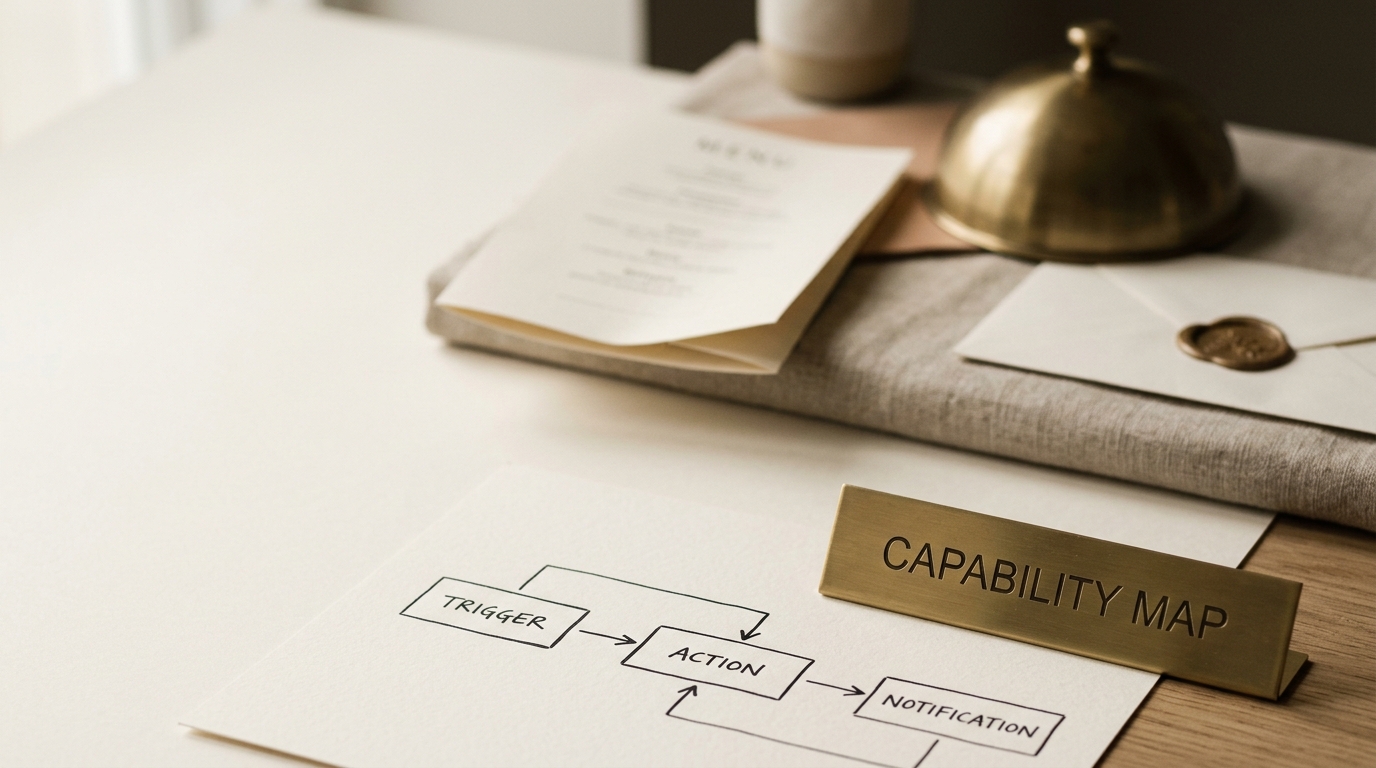
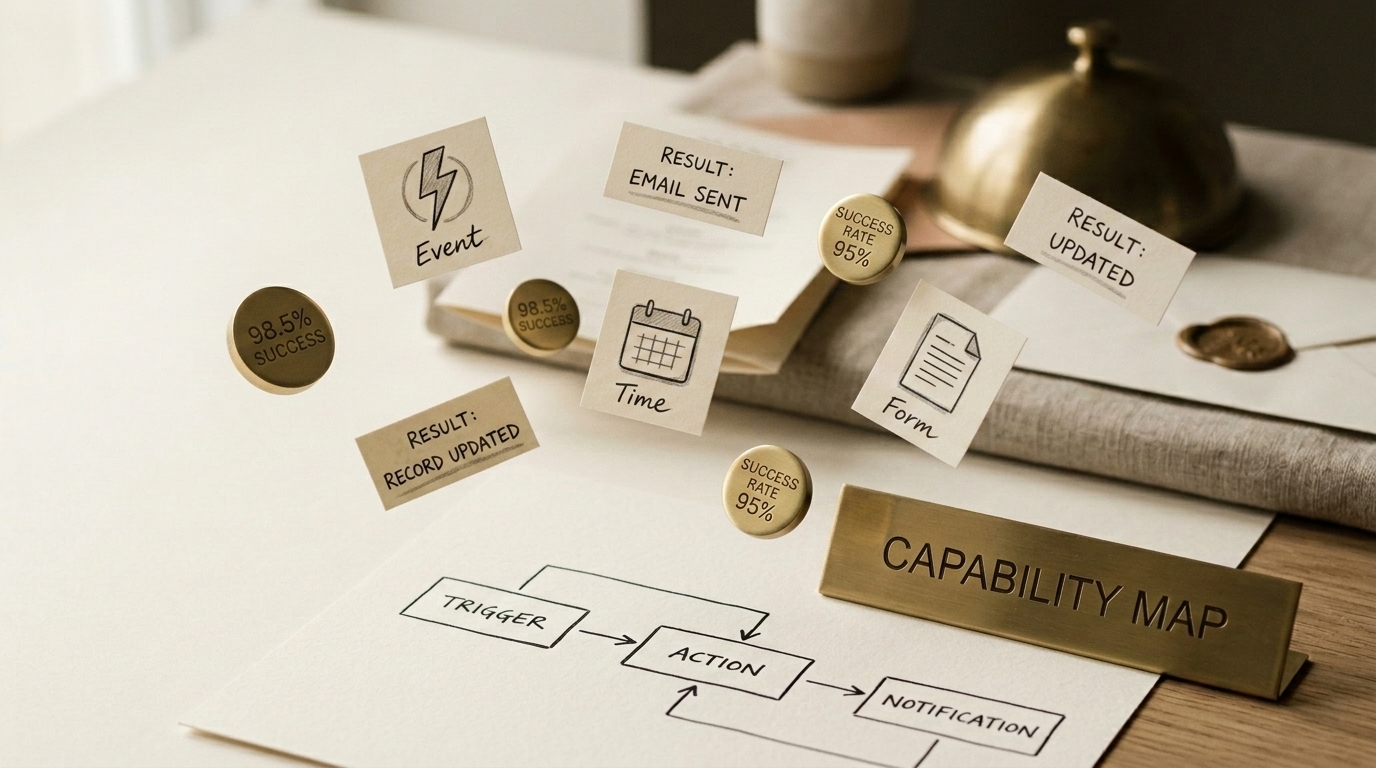
Workflow map (every trigger, condition, action)
Tuned to Hospitality, Food & Drink — the version we ship to operators in this vertical.
Lead-routing matrix with sub-5-minute escalation
Tuned to Hospitality, Food & Drink — the version we ship to operators in this vertical.
Live KPI dashboards refreshed nightly
Tuned to Hospitality, Food & Drink — the version we ship to operators in this vertical.
Operations runbook for every recurring process
Tuned to Hospitality, Food & Drink — the version we ship to operators in this vertical.
Quarterly forecast accuracy review
Tuned to Hospitality, Food & Drink — the version we ship to operators in this vertical.
SectionThe honest reframe most CRM agencies won't tell you
Most CRM agencies will sell a restaurant, a gastropub, a hotel or a catering business a HubSpot setup that was designed for a SaaS company in San Francisco. They will map the guest journey as a single list of stages — "Enquiry, Quoted, Booked, Visited, Repeat" — and call it a day. There is no integration to OpenTable, ResDiary, SevenRooms, Mews, Cloudbeds or your POS. There is no allergen-and-dietary-preference field structure. There is no loyalty programme tie-in. There is no offline conversion sync from a covered booking back to the ad platform that originated it. The CRM becomes an expensive contact list that nobody updates and the floor staff never open.
Hospitality, food and drink operators are running three or four sales motions inside one venue. A 7pm two-cover Tuesday booking is a different animal to a Friday 80-cover private hire, which is a different animal to a corporate Christmas party enquiry, which is a different animal to a B&B's seven-night peak-season stay. Restaurants need OpenTable or ResDiary or SevenRooms talking to the marketing CRM. Hotels need Mews or Cloudbeds talking to it. Toast, Square or Lightspeed POS data has to flow through. Allergen and dietary preference data has to be captured at the point of booking under Natasha's Law and propagated to the kitchen and the floor. None of that fits "Enquiry, Quoted, Booked, Visited, Repeat."
This playbook fixes the architecture, the integrations, the data capture and the loyalty mechanics. The CRM stops being a parallel address book and becomes the operating system the venue runs on. Read it, run it yourself, or have us ship it on retainer — the canon is the same.
SectionThe eight-point audit we run on day one
Score your own CRM red, amber or green this week. Three or more reds means the foundation is broken — fix that before you launch another menu, sign another corporate-events partner or open another covers channel.
- Industry CRM fit. A generic HubSpot or Pipedrive will not move covers. Restaurants need OpenTable, ResDiary or SevenRooms as the booking engine of record, with the CRM sitting alongside as the marketing-and-loyalty layer. Hotels and B&Bs need Mews or Cloudbeds as the PMS, with the CRM consuming arrivals, stays and post-stay data. Choose the booking-or-PMS platform first, choose the marketing CRM second, and make the two talk. Picking the marketing CRM in isolation is the most common five-figure error in this sector.
- POS integration. Square, Toast or Lightspeed sit on every till. The covers data, the average spend, the menu-item breakdown and the table-time signals all live in the POS. If your CRM cannot see what each guest actually ate and drank, your segmentation is fiction. POS-to-CRM integration turns "Sarah, two-cover Tuesday" into "Sarah, two-cover Tuesday, £88 spend, two glasses of the Sancerre, no starter, declined dessert" — and that record is the foundation of every loyalty and re-marketing decision downstream.
- Hotel PMS integration. For hotels, B&Bs and guesthouses, the PMS holds the booking, the rate, the stay length, the OTA channel attribution and the post-stay survey. Without Mews or Cloudbeds talking to the CRM, you cannot run a meaningful repeat-guest programme, you cannot segment by stay value, and your direct-booking nurture is built on guesswork. Most hotels are paying Booking.com 17–25% commission on stays that the CRM cannot identify or claw back.
- Allergen and dietary preference capture. Natasha's Law and the FSA allergen disclosure regime mean every venue needs a defensible, auditable capture of guest dietary requirements at the point of booking. The CRM has to hold that data, surface it on the booking record to the floor and the kitchen, and update across visits. Verbal allergen declarations passed by waiter to chef are the legal vulnerability that closes venues. The CRM-and-booking-engine integration is the audit trail.
- Loyalty and repeat-visit programme integration. A booking made through OpenTable or ResDiary should fire a CRM event that adds points, triggers a thank-you, and slots the guest into the right re-engagement cohort. A second visit inside 60 days should escalate the recognition. A 90-day silence should trigger a we-miss-you sequence. Most venues are running a loyalty platform on one island and a marketing CRM on another, and the two never converse — so the loyalty programme is invisible to the email channel and the email channel is invisible to the floor.
- Private-hire and events workflow handoff. A 60-cover Christmas party enquiry is a different sales motion to a Tuesday two-cover. It needs a quoting workflow, a deposit-and-balance schedule, a menu sign-off, an allergen schedule per guest list, and a post-event follow-up that pitches the next booking. Most hospitality CRMs have no events pipeline at all — the whole motion runs on a shared inbox and a Google Sheet. The deal slippage is real and measurable.
- Offline conversion sync to ad platforms. When a Meta or Google ad drives an OpenTable booking, that conversion event has to fire back to the platform with the cover count and average-spend value attached. Without it, the algorithm bids on the cheapest form-fillers, not the bookers who actually arrive and spend. Most hospitality CRMs are not configured for offline conversion sync. It is the single highest-leverage CRM-to-paid-media integration in the sector and the cleanest way to drop CAC by 20–35% inside a quarter.
- Data hygiene and GDPR consent. A guest who books on OpenTable, opts in for marketing on the website, and joins the loyalty programme via a QR code at the table is now in three systems with three consent records. Without a deduplication rule, a master-record policy and a GDPR consent ledger, your marketing list is part-illegal and part-fiction. The ICO complaint is one disgruntled guest away.
Three or more reds — fix the foundation before you commission new ad spend, launch a loyalty programme or sign a private-hire partnership.
SectionSix productised deliverables we ship per cycle
On a Foundation, Compound or Architect retainer, the same six outputs land in your portal each cycle. Industry-tuned, fixed scope, dated. Walk-away rights at every cycle boundary.
Industry CRM stack architecture. A documented stack with the booking engine or PMS as system of record (OpenTable, ResDiary, SevenRooms for restaurants and gastropubs; Mews or Cloudbeds for hotels and B&Bs), the POS as transaction-level truth, and the marketing CRM as the segmentation, automation and nurture layer. Field mapping, consent flow, master-record rules and integration topology are signed off in writing before any automation goes live. Forecasting becomes accurate because each booking source's repeat-rate and lifetime-value is being tracked separately. Time to first signal: 21 days. Owned by you.
POS and PMS integration. Two-way integration between the till and the CRM (Square, Toast or Lightspeed for F&B; Mews or Cloudbeds for accommodation). Each guest record gains transaction-level data — covers, average spend, menu items, table time for restaurants; arrivals, length of stay, room type, OTA channel for hotels. Segmentation moves from guesswork to evidence. The repeat-rate cohort, the high-spender cohort and the at-risk cohort become operational, not theoretical. Time to first signal: 30 days.
Allergen and dietary preference capture. A booking-engine field set, a CRM mirror and a kitchen-and-floor surface that captures dietary requirements at the point of booking, propagates them to the booking record and surfaces them on the floor app and the kitchen ticket. Natasha's Law and FSA allergen disclosure are the audit standard. Repeat guests have their allergens carried forward across visits. The verbal-handoff legal vulnerability is closed. The audit trail is defensible to the EHO and to the insurer.
Loyalty programme integration. The loyalty platform and the marketing CRM stop being islands. A booking fires a points event. A repeat visit inside 60 days fires a recognition sequence. A 90-day silence fires a we-miss-you. A high-value cohort gets pre-launch access to new menus or rooms. Loyalty becomes a CRM-driven motion, not a plastic card scheme. Repeat-visit rate typically lifts 15–25% inside two cycles on venues that did not previously have integrated loyalty.
Private-hire and events workflow handoff. A separate pipeline for events and private hire — Christmas parties, weddings, corporate dinners, B&B exclusive-use weekends. Quoting workflow, deposit-and-balance schedule, menu sign-off, allergen schedule per guest list, post-event follow-up that pitches the next booking. The events motion stops running on a shared inbox. Forecast accuracy on Q4 events revenue moves from "best guess" to a forecast the finance team will sign off. Time to first signal: 30 days.
Offline conversion sync. Bookings completed in OpenTable, ResDiary, SevenRooms, Mews or Cloudbeds fire back to Google Ads and Meta with cover count and revenue value attached. The Google Click ID and Meta Click ID are captured at the booking-engine handoff, stored on the contact record and posted back when the booking is fulfilled. The algorithm starts bidding on real customers within 30–60 days. CPL goes up, CAC goes down, no-show share drops, the reporting becomes truthful.
SectionWhat to do this week
Three actions, ranked by leverage. Same first three steps we ship in week one of a Foundation retainer for a hospitality operator.
- Audit your booking-engine and CRM split. Owner: GM or owner. Time: 1 hour. List every system that holds guest data — OpenTable, ResDiary, SevenRooms, Mews, Cloudbeds, Square, Toast, Lightspeed, Mailchimp, your loyalty platform, your website forms, your reservation phone log. If it is more than three islands and they do not converse, that is your highest-leverage fix. The integration architecture is the architectural decision that makes every other automation possible.
- Time your post-booking-to-allergen-on-kitchen-ticket flow. Owner: GM. Time: 30 minutes. Submit a test booking through your public booking engine with a peanut allergy declared. Time how long until that allergen note is visible on the floor app and the kitchen ticket. If it is over 5 minutes, or the allergen does not appear on the kitchen ticket without a verbal handoff, your Natasha's Law audit trail is broken. Most venues find their allergen capture stops at the booking engine and a waiter has to retype it.
- Decide DIY, DWY or DFY for the next 90 days. Owner: owner or GM. Time: 30-min discovery call. We will confirm the right way in writing within two business days. See the three ways.
SectionFive questions hospitality and F&B operators ask us about CRM and automation
OpenTable vs ResDiary vs SevenRooms — which one for an independent restaurant or gastropub? All three are credible booking engines and all three integrate with mainstream CRMs. OpenTable wins on inbound discovery — the diner-network is the largest in the UK and the cover-flow from the OpenTable app is real and measurable, although the per-cover fee bites at scale. ResDiary wins on commercial economics for higher-cover venues — flat monthly pricing rather than per-cover means it pays back faster once you are above 2,000 covers a month, and the data ownership is cleaner. SevenRooms wins on the CRM-and-loyalty layer itself — the platform is the closest to a guest-data-platform with bookings attached, and high-end groups running multiple sites pick it for the unified guest record. Independents under one site usually pick OpenTable for discovery or ResDiary for economics. Multi-site groups picking on guest data pick SevenRooms. Get the choice right before you commit — switching is painful.
Does POS integration with the CRM actually pay for itself? Yes, and faster than most operators expect. The reason is that segmentation moves from guesswork to evidence the day the POS data lands on the contact record. You stop emailing every diner the same thing and start emailing the high-spend cohort a different sequence to the at-risk cohort. Re-engagement campaigns to the 90-day-silent cohort produce measurable returning covers. The high-spender pre-launch cohort lifts new-menu opening-week revenue by 15–25% on most independent restaurants we have measured. Payback is typically inside one quarter. The POS-to-CRM integration also exposes the discount-leakage problem — the venues quietly losing 6–10% of covers to comp meals and unrecorded staff drinks suddenly have a real number to manage.
What is the actual revenue impact of an integrated loyalty programme? Conservative: 15–25% lift in repeat-visit rate inside two cycles, with the most pronounced effect on the at-risk cohort that was previously invisible to email. The mechanism is mechanical — a booking fires a points event, a points balance fires a recognition, a 90-day silence fires a we-miss-you with a measurable cover-back rate of 8–14%. The platform-vs-CRM integration matters more than which loyalty platform you pick. A loyalty programme running on an island that the email CRM cannot see is a sunk cost. A loyalty programme integrated to the CRM and the booking engine is a measurable repeat-revenue motion. Hotels and B&Bs see slightly lower repeat-rate uplift but higher per-stay revenue effect because the price ticket is larger.
How do we capture allergen data properly under Natasha's Law without slowing the booking flow? The booking-engine field set carries a free-text dietary requirements field plus a structured allergen tick-list (the 14 named allergens). The CRM mirrors both. The POS or floor app surfaces the allergen list on the table card the moment the guest is seated. The kitchen ticket carries the allergen flag at print. Repeat guests have their declared allergens carried forward across visits, with a confirm-or-update prompt at re-booking. The whole flow takes 4–8 weeks to land properly across booking engine, CRM, POS and kitchen, and the audit trail it produces is defensible to the EHO and the insurer. The cost of not having this flow is a six-figure event waiting to happen.
Can we run this ourselves with the playbook plus £750 audit? Yes — most of the architecture-and-fix list above is achievable in-house if you have an operations or marketing manager who owns the CRM, an integrations partner half-week and a GM who will adopt the new flows on the floor. The £750 audit gives you a written red, amber, green scoring across the eight audit points, with named-owner and dated next steps. If you sign for DWY or DFY within 30 days, the audit fee credits against the first cycle.
SectionWhere to go from here
If you want this shipped end-to-end on a productised retainer, book a 30-minute discovery call. Tailored proposal in writing within two business days.
If you would rather have a senior practitioner reviewing your team's work each week, the coaching plans start at £750/month with rolling cycles and walk-away rights. If you have a hard deadline — a menu rebrand landing in three weeks, a pre-summer covers push, a CRM-and-PMS migration that needs landing inside ten working days — the two-week embedded sprint lands a senior practitioner inside your tools for ten working days at £3,000 fixed, with a fixed deliverable list signed off before kick-off.
Or run it yourself. Read this playbook end to end, run the eight-point audit, ship one deliverable a month for six months. Twice-quarterly office hours are open to anyone using the playbooks — bring your work, get reviewed, no charge.
Get Automation & CRM for Hospitality, Food & Drink.
A focused, no-fluff playbook covering the audit, the deliverables, the success signals and the cadence we use when we run this combination for clients. Hospitality, Food & Drink-specific from the first page to the last.
No spam. One playbook, one follow-up email a week later asking what landed and what didn’t. Unsubscribe in one click.
Where the playbook ends and the engagement begins.
The framework, free
- The eight-point audit baseline so you can score your own site this week
- The six productised deliverables we ship per cycle, named and explained
- The 30/60/90 fix roadmap so you can plan internal capacity
- The three-way model (DIY / DWY / DFY) and price bands
- The success metrics we track and the time-to-signal canon
- The industry-specific regulators, sub-verticals and trust signals
What requires the call
- Named-client case studies with revenue numbers (NDA-protected)
- Our internal tooling stack and platform vendors (trade-secret)
- The proprietary scoring rubric we use to triage problems
- Specific commercial terms beyond published price bands
- Direct introductions to our partner network
- The post-engagement playbook revisions we ship per cycle
Adjacent combinations operators in this vertical also read.
Automation & CRM for Recruitment & Careers
A focused playbook for Recruitment & Careers operators running Automation & CRM.
Open the playbook → PLAYBOOKAutomation & CRM for Eco / Energy / Heating / Solar
A focused playbook for Eco / Energy / Heating / Solar operators running Automation & CRM.
Open the playbook → PLAYBOOKAI & Intelligence for Hospitality, Food & Drink
A focused playbook for Hospitality, Food & Drink operators running AI & Intelligence.
Open the playbook → PLAYBOOKSEO & Organic Growth for Hospitality, Food & Drink
A focused playbook for Hospitality, Food & Drink operators running SEO & Organic Growth.
Open the playbook →Start your Automation & CRM for Hospitality, Food & Drink programme.
Thirty-minute discovery call, free, no commitment. We’ll send a tailored band before the call and a written proposal within two business days.