
Brand & Design for Real Estate & Property — The Practitioner’s Playbook.
A focused playbook for Real Estate & Property operators running Brand & Design. The portals (Rightmove, Zoopla) extract the bulk of acquisition value — you need a proprietary moat to win instructions before the portal stage. Vendor-education content, valuation-request automations and area-page authority are where the leverage actually sits.
Brand & Design for Real Estate & Property is its own discipline.
Six things this playbook covers, end to end.
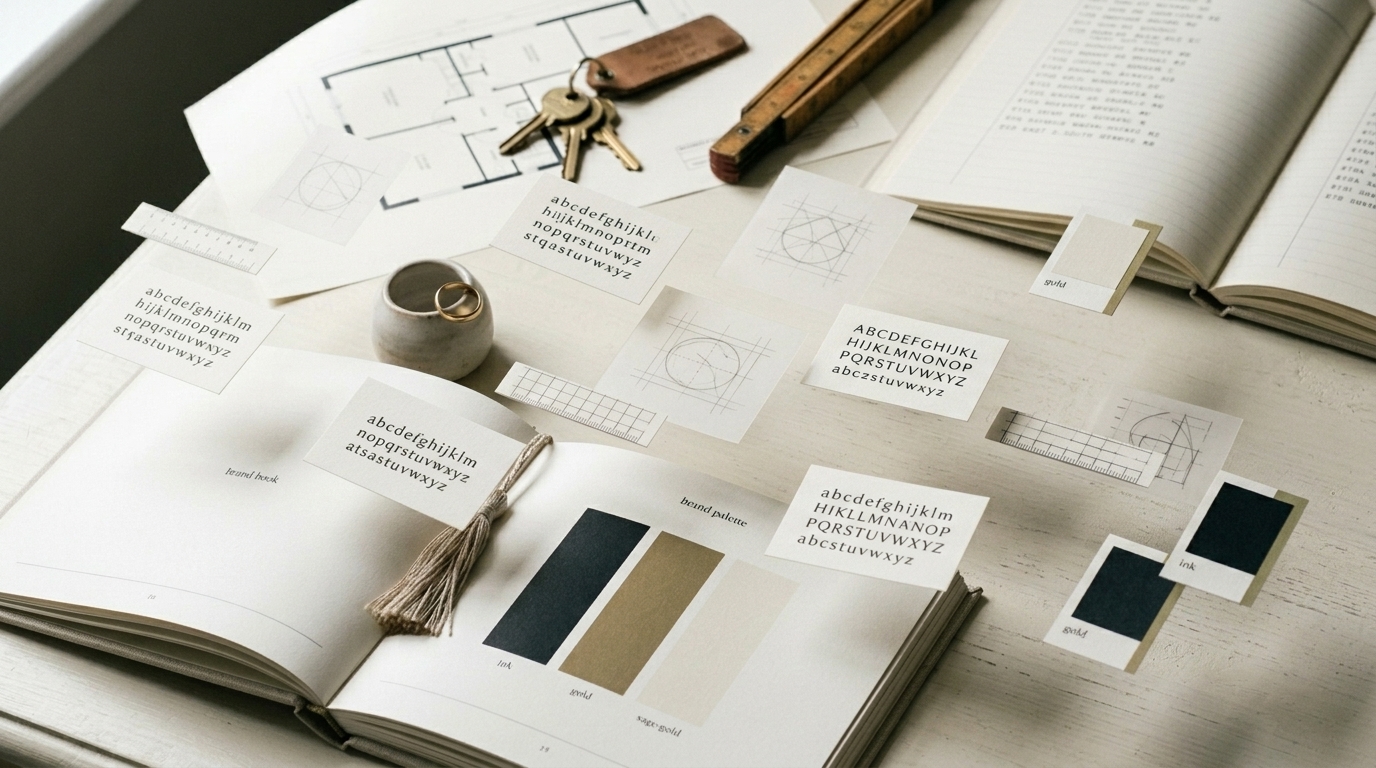
Full brand book (logo, type, colour, voice, photography)
Tuned to Real Estate & Property — the version we ship to operators in this vertical.
Logo system with mark variations and sub-brand variants
Tuned to Real Estate & Property — the version we ship to operators in this vertical.
Type pairings, scale and usage rules
Tuned to Real Estate & Property — the version we ship to operators in this vertical.
Component tokens (colour, type, spacing) for design + dev
Tuned to Real Estate & Property — the version we ship to operators in this vertical.
Marketing collateral kit (decks, brochures, signage)
Tuned to Real Estate & Property — the version we ship to operators in this vertical.
Photography brief with shot list and art-direction notes
Tuned to Real Estate & Property — the version we ship to operators in this vertical.
SectionThe honest reframe most brand agencies won't tell you
Generic brand agencies sell estate agents, letting agents and property developers a Canva-tier rebrand — new logo, new colour palette, three website mockups, a deck full of "values." Then they hand it over and disappear, and the agency wonders why their window display still looks like 2014, their property photography is shot on an iPhone in flat overcast light, and their valuers still pose against magnolia walls in cropped LinkedIn selfies.
Real estate is a trust-and-territory category. Vendors instruct on the basis of perceived competence — and that perception is built almost entirely from physical and visual signals: the property photography in the listing pack, the headshot on the valuer's business card, the livery on the "For Sale" board outside number 47, the brochure that arrives in the post for a £1.2m instruction, the Propertymark and Property Ombudsman trust marks displayed at the branch door. Generic brand agencies don't ship this stack because it requires understanding RICS firm-mark display rules, Propertymark NAEA / ARLA membership conventions, Property Ombudsman scheme display, drone-photography CAA permission requirements, and the brochure-template architecture that lets a five-branch agency produce a £2m listing pack in 40 minutes instead of three days.
This playbook fixes the structure. The photography standards are the foundation. The template architecture is the multiplier. The trust-mark display is the conversion floor. Read it, run it yourself, or have us ship it on retainer.
SectionThe eight-point audit we run on day one
Score your own brand system red / amber / green this week.
- Property-photography standards (lighting, composition, drone-aerial spec) — A written photography brief covering interior lighting (HDR bracketing, ambient + flash mix, no fisheye distortion, twilight-shoot windows for premium instructions), composition rules (one-point perspective, ceiling-height shots, kitchen/lounge/master priority), and drone-aerial spec (CAA-compliant operator, A2 CofC minimum, sub-250m altitude, agreed shot list for over-£750k instructions). Most agents leave it to whichever photographer the negotiator booked that week.
- Valuer-team headshot library — A consistent, professionally-shot headshot library for every valuer, negotiator, branch manager and director. Same backdrop, same lighting, same crop, same dress code. Updated annually. Most agents have a mix of 2018 LinkedIn selfies, 2022 Christmas-party crops, and one director shot against a window so the face is silhouetted.
- Branch-livery + window-display brand consistency — Window-display vinyl, internal signage, fascia, business cards, valuer folders, viewing-pack covers, and even the iPad case at the front desk all carrying the same brand system. Window-display rotation rules: featured-instruction layout, sold-banner overlay, instruction-availability layout. Most multi-branch agents have three different versions of the brand running in parallel because each branch reordered livery from a different printer.
- RICS / Propertymark / Property Ombudsman trust-mark display — RICS firm-mark (where applicable), Propertymark NAEA and / or ARLA logos with membership numbers, Property Ombudsman scheme membership, FCA registration (for in-house mortgage brokers or financial-advice referrals), Information Commissioner's Office registration. Displayed at branch entrance, on the website footer, on letterheads, on instruction-pack covers. Most agents have one or two of these on the website footer in 9pt grey and miss the others entirely.
- Brochure + listing-pack template architecture — A master template system covering: standard listing brochure (4pp, 8pp, 12pp), premium listing brochure (16pp, hardback for over-£1m), letting-pack cover, vendor-onboarding pack, valuation-report cover, instruction-letter letterhead, viewing-feedback sheet. Built so a negotiator can produce a £2m listing pack in 40 minutes by dropping in photos and copy. Most agents rebuild every brochure from scratch in Word.
- "For Sale" / "Sold" / "Let" board livery — Consistent board design across all instruction types. Branded board frame, agreed colour system (sale vs let, residential vs commercial), "Sold" and "Let Agreed" overlay strips, branch phone number and website at correct hierarchy. Most agents have boards from three different printers running in parallel and a "Sold" sticker that is a different shade of red to the underlying board.
- Brand voice + tone documented — A written brand-voice document covering tone (formal vs warm, traditional vs modern), vocabulary do/don't list (e.g. "townhouse" not "town house"; "instructed by" not "selling for"), property-description style guide, valuation-report tone, social-media tone. Most agents leave it to whichever negotiator wrote that listing on a Friday afternoon.
- Production-asset DAM — A digital-asset management system holding all photography (raw + edited, named to a convention with property reference, room, shot type), brochure templates (current + archived), brand-asset library (logos, board overlays, livery files), valuer headshots, drone footage, and instruction-pack PDFs. Searchable, permissioned, version-controlled. Most agents have it all on the senior negotiator's iPhone and a shared Dropbox folder that no one cleaned out since 2021.
Three or more reds — fix the foundation before commissioning a new website, ordering new boards, or paying for premium-listing portal upgrades.
SectionSix productised deliverables we ship per cycle
Property-photography standards + brief. A written photography brief covering interior lighting (HDR bracketing, ambient + flash mix, twilight-shoot trigger thresholds), composition rules, room priority lists, and drone-aerial spec (CAA A2 CofC operator, agreed altitude and shot list, weather and noise-abatement parameters). Plus a vetted-photographer panel — two to four photographers per branch radius — briefed on the standard. Plus a pre-listing photo-checklist for the negotiator so substandard sets never reach the listing pack. Time to first signal: 30 days.
Valuer-team headshot library. A full-team headshot shoot — every valuer, negotiator, branch manager, director — same backdrop, same lighting, same crop, same dress code. Three crops per person (square for portal, landscape for website, vertical for social). Annual refresh contracted in. Naming convention and DAM-loaded so the marketing manager can pull a director shot for a press release without asking. Time to first signal: 14 days.
Branch livery + window-display system. A master livery file pack covering window-display vinyl (featured-instruction, sold-banner, instruction-availability layouts), internal signage, fascia, business cards, valuer folders, viewing-pack covers, branded merchandise. Signed off and supplied to a single approved printer so colour and stock match across branches. Window-display rotation calendar so each branch knows what's in the window each fortnight.
Trust-mark display licensing. A documented trust-mark display package covering RICS firm-mark (where the firm is a regulated RICS firm), Propertymark NAEA / ARLA logos with current membership numbers, Property Ombudsman scheme number, FCA registration, ICO registration, Trading Standards Approved Code (where applicable). Displayed at branch entrance, in window display, on website footer, on letterhead, on instruction-pack cover, on email signatures. Annual renewal-tracker so a lapsed Propertymark membership doesn't sit on a window vinyl for six months. Time to first signal: 21 days.
Brochure + listing-pack templates. A master template system in InDesign (or equivalent) covering: standard listing brochure (4pp, 8pp, 12pp), premium listing brochure (16pp, hardback option for over-£1m), letting-pack cover, vendor-onboarding pack, valuation-report cover, instruction-letter letterhead, viewing-feedback sheet, EPC-summary insert. Built so a negotiator drops in photos and the template handles layout, typography, hierarchy, trust-mark display and footer compliance. Plus a written usage guide and 30-minute training session per branch.
"For Sale" / "Sold" board livery. A board-livery pack covering board design (residential sale, residential let, commercial), "Sold" and "Let Agreed" overlay strips, "Under Offer" interim livery, board-frame specification (timber vs composite, height, post profile), branch-phone and website-URL hierarchy. Supplied to a single approved board contractor with branch-by-branch delivery agreed. Replacement-board reorder process documented so a damaged board on Wimborne Road is replaced in 48 hours not three weeks.
SectionWhat to do this week
Three actions, ranked by leverage.
- Walk past your own branch and shoot it on your phone. Owner: founder or marketing manager. Time: 20 minutes. Window display, fascia, board outside, board livery, trust-mark display at the door, business card on the front desk. Lay the photos side-by-side with a competitor branch on the same high street. Most directors discover their window vinyl is two years out of date and the competitor's is sharper than theirs.
- Open your last six brochures and lay them flat. Owner: founder or senior negotiator. Time: 15 minutes. Are the headshots on the back cover the same crop? Same lighting? Are the trust-mark logos in the same position? Is the property-description tone consistent? Most agents discover six different brochure versions running in parallel, none of them on the current brand.
- Decide DIY, DWY or DFY for the next 90 days. Owner: founder. See the three ways.
SectionFive questions estate-agent / property operators ask us about brand & design
Does professional property photography actually return the investment? Yes, and the data is unambiguous. Rightmove's own analysis of click-through rates shows professionally-shot listings generate 2–3x the views of phone-shot equivalents in the same price band, and instructions converted from second-viewing to offer at meaningfully higher rates. On a £450k instruction at 1.2% commission, that's £5,400 in fee — a single instruction pays for a full year of vetted-photographer panel access. The agents who say "our negotiators take great photos" are usually the ones losing to the agent down the road who books a vetted property photographer for every instruction over £350k.
Will refreshed valuer headshots really change instruction conversion? They change vendor confidence at the listing-presentation stage, which is the conversion-event that matters. A vendor inviting three agents in for valuation pitches makes the decision in the first 90 seconds — and if your director's headshot on the leave-behind brochure is a 2018 LinkedIn selfie while the competitor's is a recent professionally-shot portrait, you have ceded the trust signal before the conversation started. Same logic applies to website Meet The Team pages, where buyers and vendors research valuers before invitation.
What conversion lift do brochure-template upgrades produce? Two effects. First: time-to-pack collapses — a £2m listing pack that took a senior negotiator three days to produce now takes 40 minutes, freeing 20+ hours per branch per month. Second: vendor-meeting close rate rises because the leave-behind looks like a £2m firm not a £200k firm. The economic case is the time-saving alone; the conversion lift is the multiplier on top.
What does a proper "For Sale" board livery system actually cost? One-off design + spec investment is £1,200–£3,000 depending on board variants (sale, let, commercial, sold overlays, under-offer). Per-board ongoing cost is broadly the same as you're paying now; the difference is consistency. The hidden cost is the current state — three printers, three colour systems, mismatched "Sold" overlays — which costs you brand equity every time a buyer drives past a competitor's tighter livery on the same street.
Can we run this ourselves with the playbook + £750 audit? Yes. The photography brief is achievable in-house with a marketing-manager fortnight. The trust-mark display package is a one-off documentation exercise. The brochure templates are the highest-leverage piece — those are usually worth bringing in a senior designer for two to three weeks. The £750 audit gives you a written red/amber/green of all eight points + named-owner / dated next steps. Credit toward first cycle if you sign for DWY/DFY within 30 days.
SectionWhere to go from here
If you want this shipped end-to-end on a productised retainer, book a 30-minute discovery call.
If you'd rather have a senior practitioner reviewing your team's brochure builds, photography sets and window-display rotation each week, the coaching plans start at £750/month. The two-week embedded sprint at £3,000 fixed is the right call for new-branch launches or rebrand windows where you need photography standards, brochure templates and board livery live before the launch campaign.
Or run it yourself. Eight-point audit + one deliverable a month + twice-quarterly office hours.
Get Brand & Design for Real Estate & Property.
A focused, no-fluff playbook covering the audit, the deliverables, the success signals and the cadence we use when we run this combination for clients. Real Estate & Property-specific from the first page to the last.
No spam. One playbook, one follow-up email a week later asking what landed and what didn’t. Unsubscribe in one click.
Where the playbook ends and the engagement begins.
The framework, free
- The eight-point audit baseline so you can score your own site this week
- The six productised deliverables we ship per cycle, named and explained
- The 30/60/90 fix roadmap so you can plan internal capacity
- The three-way model (DIY / DWY / DFY) and price bands
- The success metrics we track and the time-to-signal canon
- The industry-specific regulators, sub-verticals and trust signals
What requires the call
- Named-client case studies with revenue numbers (NDA-protected)
- Our internal tooling stack and platform vendors (trade-secret)
- The proprietary scoring rubric we use to triage problems
- Specific commercial terms beyond published price bands
- Direct introductions to our partner network
- The post-engagement playbook revisions we ship per cycle
Adjacent combinations operators in this vertical also read.
Brand & Design for Health & Wellbeing
A focused playbook for Health & Wellbeing operators running Brand & Design.
Open the playbook → PLAYBOOKBrand & Design for Professional Services & B2B
A focused playbook for Professional Services & B2B operators running Brand & Design.
Open the playbook → PLAYBOOKSocial Media Management for Real Estate & Property
A focused playbook for Real Estate & Property operators running Social Media Management.
Open the playbook → PLAYBOOKContent & Editorial for Real Estate & Property
A focused playbook for Real Estate & Property operators running Content & Editorial.
Open the playbook →Start your Brand & Design for Real Estate & Property programme.
Thirty-minute discovery call, free, no commitment. We’ll send a tailored band before the call and a written proposal within two business days.