

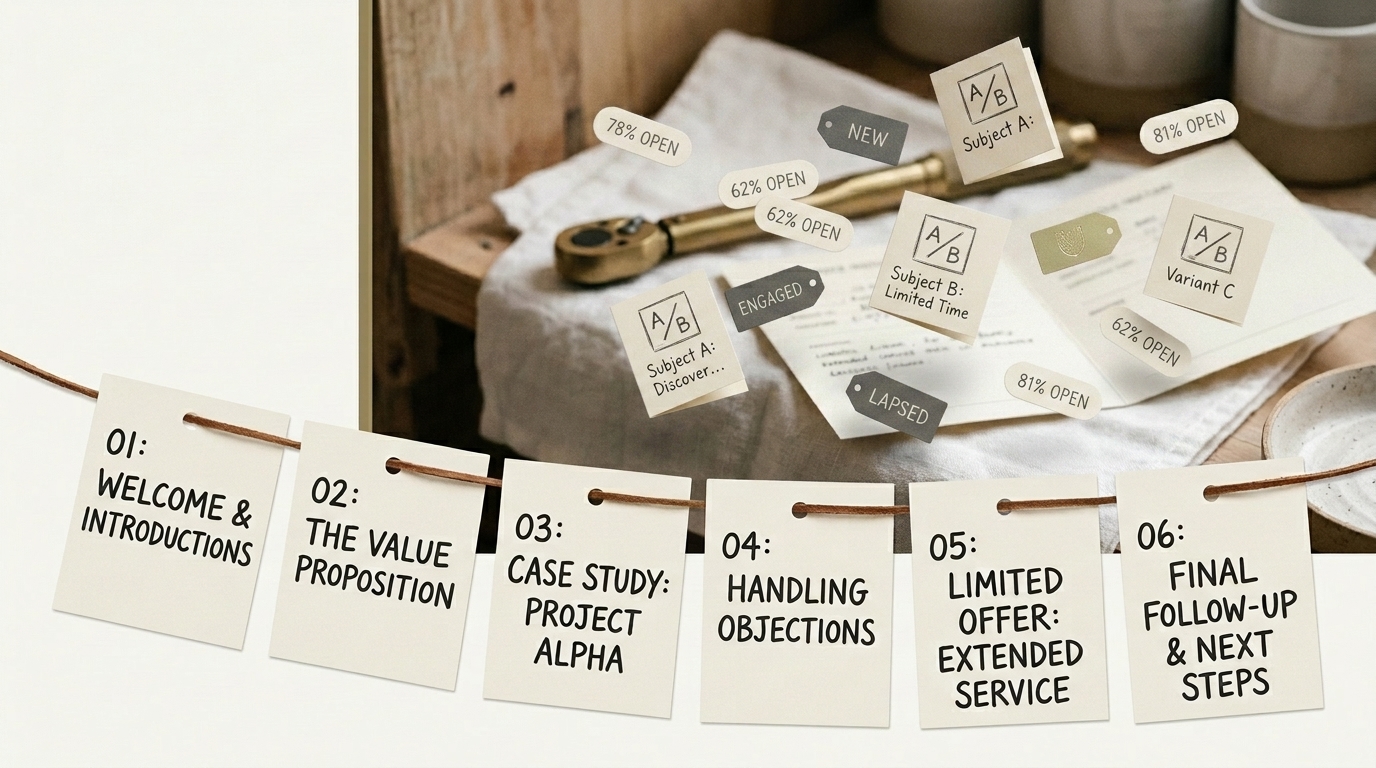
Email Marketing for Automotive — The Practitioner’s Playbook.
A focused playbook for Automotive operators running Email Marketing. "Near me" intent is the entire game in automotive, and most dealers, workshops and aftermarket operators leak it to local-pack noise. Service, MOT, tyre-fit and aftermarket bookings are higher-margin than sales but rarely treated as their own funnel.
Email Marketing for Automotive is its own discipline.
Six things this playbook covers, end to end.
Welcome, nurture and re-engagement sequence design
Tuned to Automotive — the version we ship to operators in this vertical.
Lifecycle map with behavioural triggers
Tuned to Automotive — the version we ship to operators in this vertical.
Branded mobile-first template kit
Tuned to Automotive — the version we ship to operators in this vertical.
Deliverability checklist (SPF, DKIM, DMARC, BIMI)
Tuned to Automotive — the version we ship to operators in this vertical.
Segmentation playbook (behavioural / lifecycle / value)
Tuned to Automotive — the version we ship to operators in this vertical.
Send-time, subject-line and offer test calendar
Tuned to Automotive — the version we ship to operators in this vertical.
SectionHonest reframe
Generic email agencies sell dealers a Mailchimp list and a monthly "newsletter" with three new arrivals, a Bank Holiday banner and a "book a service" footer. No DMS-driven personalisation. No service-cycle automation. No idea which customers are 30 days from MOT, 90 days from end-of-finance-term, or sitting on tyres at 2.1mm tread depth. The send goes out at 10am on a Tuesday to thirty thousand addresses, opens at 14%, clicks at 1.2%, and produces three bookings the workshop manager attributes to luck.
Automotive email is not a newsletter category. It is a behavioural-trigger category. The DMS knows when each customer's MOT expires, when their service is due, when their tyre tread last failed inspection, when their finance agreement's optional final payment is six months away, and when the next plate-change window opens. Pinnacle, Keyloop and Drivex all expose this data. Most dealers never wire it to a sending platform. The result: thirty thousand subscribers paying for a list they never personalise, while their highest-LTV trigger — end-of-finance-term — fires zero automated emails per month.
This playbook fixes the architecture. Service-cycle reminders are the volume layer. End-of-finance-term campaigns are the margin layer. FCA-compliant disclosure is the trust layer. Plate-change-window urgency is the seasonal multiplier. Read it, run it yourself, or have us ship it on retainer — the canon is the same.
SectionEight-point audit
Score your own email programme red / amber / green this week. Three or more reds means the foundation is broken — fix that before commissioning any new list growth.
- SPF, DKIM, DMARC and BIMI deliverability hardening — All four records published, with DMARC at
p=quarantineminimum and a reporting mailbox. BIMI logo registered against a Verified Mark Certificate so your dealer logo renders next to the sender name in Gmail and Apple Mail. Without these, Outlook for Business and Gmail Promotions tabs treat your sends as low-trust; deliverability decay is silent and compounds month-over-month. - DMS-driven personalisation (Pinnacle, Keyloop or Drivex feeding service and ownership data) — Every send pulls live DMS fields: VRM, make, model, derivative, year, mileage at last service, MOT expiry date, last service date, finance agreement type, monthly payment, optional final payment, agreement end date. If your sends say "Dear Customer" or list "the latest offers" without referencing the actual vehicle on the driveway, you are leaving 70% of the lift on the table.
- MOT-due, service-due and tyre-due reminder automation — T-60, T-30, T-14, T-7 and T-1 sequences for MOT; service-interval reminders pegged to manufacturer schedule and live mileage; tyre-tread alerts triggered by inspection notes from the workshop. Each sequence routed to the workshop calendar with one-tap booking. Most dealers run the T-30 manually and skip the rest; the lift comes from the cadence, not the single send.
- End-of-finance-term renewal campaigns (the highest-LTV trigger) — T-180, T-120, T-90, T-60, T-30 sequences keyed to agreement end date, with finance-product education (PCP renewal versus part-exchange-and-upgrade versus voluntary termination), comparable in-stock vehicles in the same monthly band, and a finance pre-qualification CTA. This is where dealers leave the most money on the table — a T-180 trigger lets you pull the customer back into showroom flow before the manufacturer's captive finance arm or a competitor sends their renewal letter.
- Plate-change-window urgency campaigns (March and September) — Six-to-eight-week pre-flight sequences ahead of the 1 March and 1 September registration changes. Registered-interest captures in January and July, model-derivative quote-flows mid-February and mid-August, delivery-slot waitlists, and a final 72-hour-window sequence in the last week before the change. Without this, you are watching your competitor own the search demand spike and the showroom traffic surge.
- FCA-compliant finance comms with APR and representative example — Any email referencing finance must carry the representative example: APR, total cost of credit, fees, deposit, term, optional final payment, total amount payable. The CONC sourcebook applies to email as much as to forecourt boards. "From £199/month" without the surrounding example is a CONC breach. Build the disclosure once as a template block and lock it.
- Transactional (job-completion) versus marketing separation — Booking confirmations, MOT pass certificates, service invoices, courtesy-car handover notes and parts-arrival pings must run on a transactional sub-domain or a separated stream — never mixed with the marketing list. Conflating the two crashes deliverability on both sides; the recipient marks the marketing send as spam and the booking confirmation goes to junk for the next twelve months.
- Suppression and GDPR housekeeping — Hard-bounce auto-suppression, soft-bounce escalation rules, unsubscribe handling within 24 hours, double-opt-in on web forms, age-of-consent audit (anyone older than 24 months without engagement gets a re-permission flow), DPA on the sending platform, retention schedule documented. The ICO will fine you if a complaint lands and the audit trail is missing.
Three or more reds — fix the foundation before commissioning new list growth.
SectionSix productised deliverables
On a Foundation, Compound or Architect retainer, the same six outputs land in your portal each cycle. Industry-tuned, fixed scope, dated.
Deliverability hardening. SPF, DKIM, DMARC and BIMI fully configured against your sending domain, with DMARC moved to p=quarantine then p=reject over a 60-day ramp. BIMI logo registered against a VMC so the dealer mark renders in Gmail and Apple Mail. Sub-domain segmentation between transactional, marketing and one-to-one sales sends. Postmaster Tools and Outlook SNDS monitored weekly with a written delta report. Inbox-placement testing across Gmail, Outlook, Apple Mail and Outlook for Business. Time to first signal: 21 days. Owned by you.
DMS-driven personalisation. Two-way integration between Pinnacle, Keyloop or Drivex and your sending platform (Klaviyo, HubSpot, Iterable, Mailchimp Premium or DMS-native), pulling VRM, derivative, mileage, MOT date, service date, finance product, agreement end date and optional-final-payment as merge fields. Personalisation logic reviewed quarterly against schema changes in the DMS feed. Every marketing send carries at least three personalised fields, not just first-name. Time to first signal: 14 days.
Service-cycle reminder automation. MOT, interim service, full service, tyre-tread and brake-pad sequences built once, fired automatically off DMS triggers. Each sequence has T-60, T-30, T-14, T-7 and T-1 cadence with channel-stacking (email plus SMS plus optional WhatsApp Business). Booking calendar tied to workshop availability; one-tap rebook for missed slots; technician-assignment rules respected. Show-rate typically lifts 18–32% versus single-send manual reminders.
End-of-finance-term renewal campaigns. T-180 through T-30 sequence keyed to agreement end date, with finance-product education (PCP renewal, HP run-off, voluntary termination, part-exchange and upgrade). Each send carries comparable in-stock vehicles in the same monthly-payment band, a soft-search pre-qualification CTA via iVendi, Codeweavers or ZutoFinance, and the FCA representative example locked at template level. The single highest-margin email programme a dealer can run; typically lifts retention-into-second-finance-deal by 10–22 percentage points.
Plate-change-window urgency. Six-to-eight-week pre-flight cadence ahead of 1 March and 1 September, with January and July registered-interest captures, mid-February and mid-August quote-flow sends, delivery-slot waitlist confirmations, and a final 72-hour T-3 / T-1 / T-0 sequence in the last week. Pre-warmed remarketing audiences exported to Google Ads and Meta Customer Match for paid-channel coordination. Most dealers double their plate-change-window enquiry volume without lifting media spend.
FCA-compliant finance comms. Representative-example block built once, locked at template level, version-controlled against CONC sourcebook updates. APR, total cost of credit, fees, deposit, term, optional final payment, total amount payable, and the legally required typeface and prominence rendering. Compliance review pre-launch and quarterly thereafter. Gives the sales team confidence to reference monthly figures in email without flinching at every send.
SectionWhat to do this week
Three actions, ranked by leverage. Same first three steps we ship in week one of a Foundation retainer for a dealer or independent garage.
- Pull a DMS export of customers 90 to 180 days from end-of-finance-term. Owner: sales manager or finance controller. Time: 60 minutes. Open Pinnacle, Keyloop or Drivex. Filter customers whose finance agreement ends in the next 90 to 180 days. Count them. Multiply by your average front-end-plus-back-end gross per sold unit. That number is the amount of money sitting in your DMS that you are not currently emailing. Most dealers find this number sits between £80,000 and £400,000 per quarter.
- Audit one marketing send for FCA compliance. Owner: founder or compliance officer. Time: 30 minutes. Open the most recent marketing email referencing finance. Check whether the representative example is present, complete and prominent: APR, total cost of credit, fees, deposit, term, optional final payment, total amount payable. If any field is missing or buried in 8-point grey type below a CTA, you have a CONC issue. Fix the template before the next send.
- Decide DIY, DWY or DFY for the next 90 days. Owner: founder. See the three ways.
SectionFive questions car-dealer / garage operators ask us about email
What's the actual ROI of an end-of-finance-term campaign? The single highest-margin email programme a franchise or independent dealer can run. A T-180 to T-30 sequence keyed to agreement end date, with comparable-vehicle and pre-qualification CTAs, typically lifts retention-into-second-finance-deal by 10–22 percentage points. On a 600-unit-per-year independent dealer with average gross of £1,800 per sold unit, that is £108,000 to £237,000 of incremental gross per year on a programme that costs less than £15,000 to build and run. The mechanism is simple: you reach the customer before the captive finance arm or a competitor sends their renewal letter, and you carry the relationship forward.
What lift do we get from MOT and service reminder automation? Workshop-bay utilisation typically lifts 12–25% inside one quarter when T-60 / T-30 / T-14 / T-7 / T-1 cadences fire automatically off DMS triggers, with booking calendar integration. Service-department revenue lifts 8–18% on the same fleet of customers, mostly through earlier rebooking and reduced no-show rate. The lift is in the cadence, not the single send — single T-30 emails barely move the needle, but the stacked sequence with channel-stacking (SMS plus email) and one-tap rebook converts customers who would otherwise have drifted to a fast-fit chain.
How do we make finance email comms FCA-compliant without sounding like a legal notice? Lock the representative example at template level so the sales team never has to think about it. Build one block — APR, total cost of credit, fees, deposit, term, optional final payment, total amount payable — in the typeface and prominence the CONC sourcebook requires. Version-control it against regulatory updates. Then write the body copy of every send around the disclosure, not despite it. The compliant send and the persuasive send are not opposed; the discipline is template architecture, not creative compromise.
Is our deliverability really that bad? We get plenty of opens. Open rate is a vanity metric since Apple Mail Privacy Protection in 2021. The signals that matter are inbox-placement (are you in Promotions, Updates or Primary in Gmail? Junk or Inbox in Outlook for Business?), spam-complaint rate (under 0.10% on every send), and engagement decay (are you losing 2–4% of active subscribers per month to inactivity?). Most dealers we audit have SPF and DKIM right but DMARC unconfigured or stuck at p=none, no BIMI, and transactional and marketing on the same domain. The fix is a 60-day ramp, not a one-day sprint.
Can we run this ourselves with the playbook + £750 audit? Yes — most dealers and garages can ship the deliverability hardening, DMS personalisation, service-cycle automations and FCA template lock in-house with a marketing manager, a developer half-week, and DMS support from your provider, especially if you are already running Pinnacle, Keyloop or Drivex with a finance platform like iVendi or Codeweavers. The £750 audit gets you a written red / amber / green scoring + named-owner / dated next steps + an FCA disclosure check on three live sends + a deliverability and DMARC alignment report. If you sign for DWY or DFY within 30 days, the audit fee credits against the first cycle.
SectionWhere to go from here
If you want this shipped end-to-end on a productised retainer, book a 30-minute discovery call. Tailored proposal in writing within two business days.
If you'd rather have a senior practitioner reviewing your team's work each week, the coaching plans start at £750/month with rolling cycles and walk-away rights. If you have a hard deadline — plate-change-window prep for March or September, an end-of-finance-term campaign launch, a deliverability rebuild after a Gmail or Outlook for Business reputation drop — the two-week embedded sprint lands a senior practitioner inside your tools and DMS for ten working days at £3,000 fixed.
Or run it yourself. Eight-point audit + one deliverable a month + twice-quarterly office hours.
Get Email Marketing for Automotive.
A focused, no-fluff playbook covering the audit, the deliverables, the success signals and the cadence we use when we run this combination for clients. Automotive-specific from the first page to the last.
No spam. One playbook, one follow-up email a week later asking what landed and what didn’t. Unsubscribe in one click.
Where the playbook ends and the engagement begins.
The framework, free
- The eight-point audit baseline so you can score your own site this week
- The six productised deliverables we ship per cycle, named and explained
- The 30/60/90 fix roadmap so you can plan internal capacity
- The three-way model (DIY / DWY / DFY) and price bands
- The success metrics we track and the time-to-signal canon
- The industry-specific regulators, sub-verticals and trust signals
What requires the call
- Named-client case studies with revenue numbers (NDA-protected)
- Our internal tooling stack and platform vendors (trade-secret)
- The proprietary scoring rubric we use to triage problems
- Specific commercial terms beyond published price bands
- Direct introductions to our partner network
- The post-engagement playbook revisions we ship per cycle
Adjacent combinations operators in this vertical also read.
Email Marketing for Recruitment & Careers
A focused playbook for Recruitment & Careers operators running Email Marketing.
Open the playbook → PLAYBOOKEmail Marketing for Events & Entertainment
A focused playbook for Events & Entertainment operators running Email Marketing.
Open the playbook → PLAYBOOKProgrammatic Web Development for Automotive
A focused playbook for Automotive operators running Programmatic Web Development.
Open the playbook → PLAYBOOKBrand & Design for Automotive
A focused playbook for Automotive operators running Brand & Design.
Open the playbook →Start your Email Marketing for Automotive programme.
Thirty-minute discovery call, free, no commitment. We’ll send a tailored band before the call and a written proposal within two business days.