Email Marketing for Events & Entertainment — The Practitioner’s Playbook.
A focused playbook for Events & Entertainment operators running Email Marketing. Event marketing collapses when the drumbeat starts week-of — the 8-12 week pre-event programme is where the economics actually work. Tickets, hospitality, sponsorship and broadcast are four different audiences and need four different funnels.
Email Marketing for Events & Entertainment is its own discipline.
Six things this playbook covers, end to end.
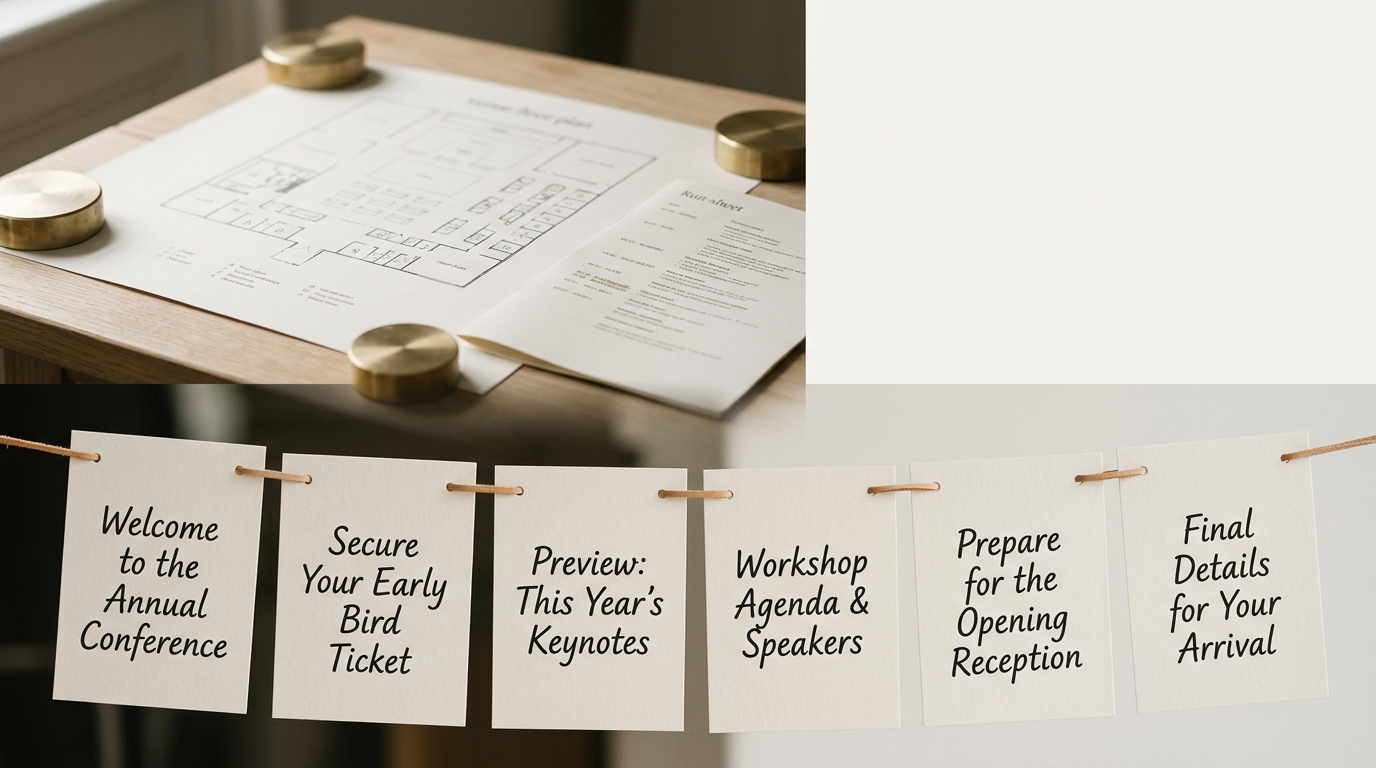
Welcome, nurture and re-engagement sequence design
Tuned to Events & Entertainment — the version we ship to operators in this vertical.
Lifecycle map with behavioural triggers
Tuned to Events & Entertainment — the version we ship to operators in this vertical.
Branded mobile-first template kit
Tuned to Events & Entertainment — the version we ship to operators in this vertical.
Deliverability checklist (SPF, DKIM, DMARC, BIMI)
Tuned to Events & Entertainment — the version we ship to operators in this vertical.
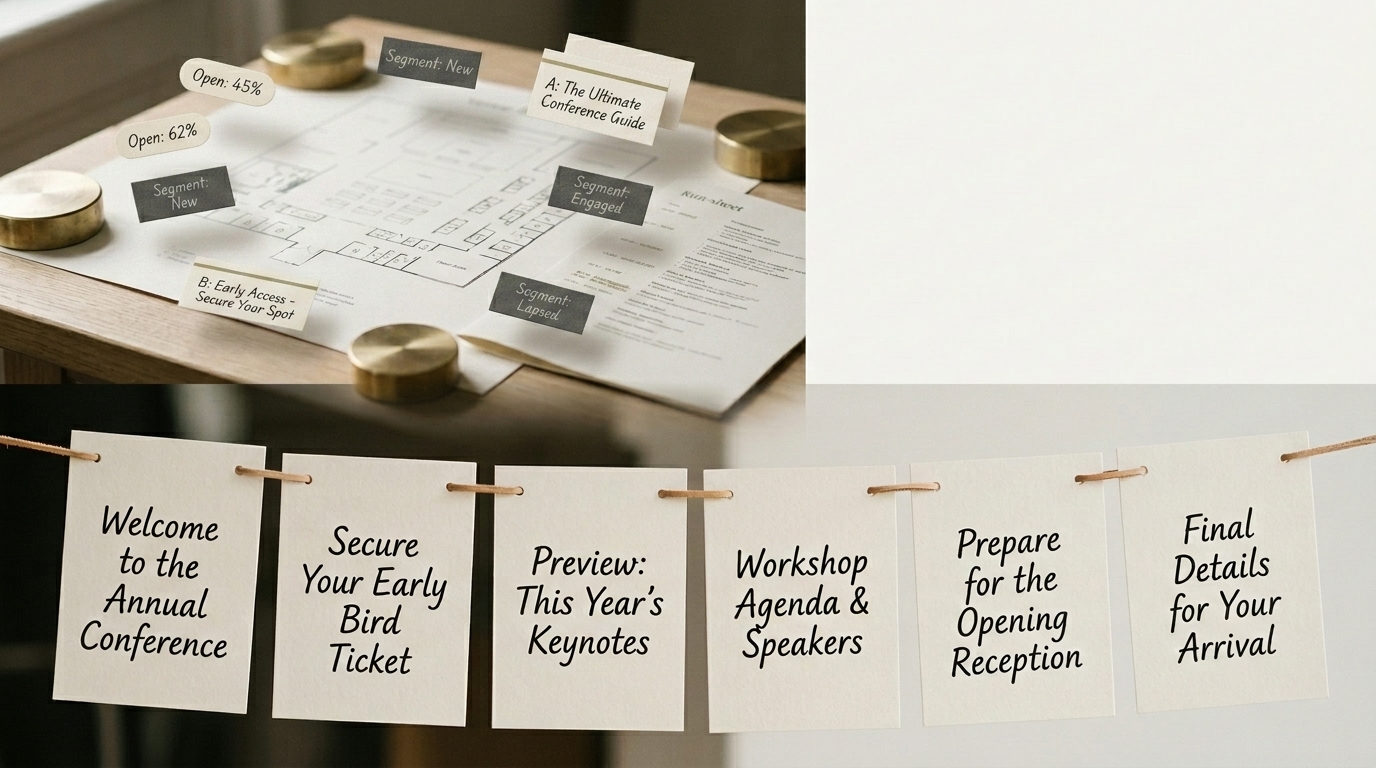
Segmentation playbook (behavioural / lifecycle / value)
Tuned to Events & Entertainment — the version we ship to operators in this vertical.
Send-time, subject-line and offer test calendar
Tuned to Events & Entertainment — the version we ship to operators in this vertical.
SectionThe honest reframe most email-marketing agencies won't tell you
Generic email-marketing agencies sell wedding venues, photographers, DJs and planners a monthly newsletter blast and a Mailchimp template refresh. They send the same "summer wedding inspiration" mailer to a couple who got engaged at Christmas, a couple who toured last March, a couple who signed a contract in February for a date 18 months out, and a wife who got married four months ago and is now hen-party planning for her sister. Four buyer-stages, one mailer, zero conversion.
Events and entertainment is not a flat list business. It's a 12-24 month wedding cycle where the same address moves through engagement, enquiry, tour, contract, planning, wedding-week and post-wedding ambassador stages — and each stage has a completely different message that converts. It's a Q1 enquiry-peak that compresses 35-45% of the year's openable, click-through-able audience into ten weeks. It's a supplier-collaboration economy where the photographer's list, the florist's list and the venue's list are the same couples ranked differently — and cross-promotion is the cheapest acquisition channel in the category.
A list with no cycle-stage tag is not a list — it's a spreadsheet. A Q1 cadence that matches the rest of the year's cadence is leaving 30-40% of the annual revenue on the table. A post-event audience treated as "marketed-to" rather than "ambassador-recruited" wastes the highest-leverage referrer in the funnel.
This playbook fixes the structure. Stage-aware nurture is the core. Q1-peak cadence is the operational lever. Supplier collaboration and post-event ambassador programmes are the compounding flywheel. Read it, run it yourself, or have us ship it on retainer — the canon is the same.
SectionThe eight-point audit we run on day one
Score your own email programme red / amber / green this week. Three or more reds means the foundation is broken — fix that before any new spend.
- SPF / DKIM / DMARC + BIMI deliverability hardening — Without correctly published SPF, DKIM and DMARC records, your wedding-cycle mailers land in the Promotions tab at best and the spam folder at worst. Most venues we audit have SPF that doesn't include their sending platform, DKIM that signs only half the streams (transactional separate from marketing), and no DMARC policy at all. BIMI — the brand-logo-in-the-inbox standard — requires a verified mark and a p=quarantine or stricter DMARC policy, and it lifts open rates 5-10% by adding visual trust to the sender line. This is the foundation; everything else is built on it.
- 12-24 month wedding-cycle nurture sequence — Seven stages, seven different messages: engagement (1-3 months in, "you're engaged, here's how to start"), enquiry (we received your enquiry, here's what to expect), tour (booked but not visited, pre-tour info pack), contract (signed but not planning yet, milestone reminders), planning (6-12 months out, supplier introductions and timeline coaching), wedding-week (final logistics, day-of comms), post-wedding (thank you, review request, ambassador recruitment). One nurture sequence, seven stages, seven CRM tags, seven message variants.
- Q1-peak email cadence (Jan-Mar weekly, rest-of-year fortnightly) — Engagement-season dictates the calendar. January through March is when 35-45% of UK couples get engaged, start enquiring and book tours. Weekly cadence to engagement-stage and enquiry-stage segments through Q1; fortnightly through Q2-Q4. Most venues run the same monthly cadence year-round and underperform Q1 by 30-40% against what the open-rate ceiling would allow.
- Tour-booked-but-not-contracted re-engagement — The single highest-leverage segment in the venue funnel. A couple who toured but hasn't signed inside 14 days is 70-80% likely to be choosing between you and one or two competitors, and the email sequence in the next 21 days decides which way it tips. Most venues send nothing here, or one generic "did you have any questions" follow-up. The right sequence is four touches: tour debrief + bespoke quote, addressing-the-objection email (parking, accommodation, supplier flexibility), social-proof case-study email with a recent same-month wedding, and a soft-deadline availability prompt.
- Supplier-collaboration cross-promotion campaigns — Venues, photographers, florists, planners and DJs serve the same couple at different stages. A four-supplier round-robin email programme (one supplier mailer to the other three's lists per month, audience consent and GDPR-aligned) builds the cheapest-quality acquisition channel in the category. Most operators do this ad-hoc with one-off swaps; a productised quarterly programme with shared content kits, attribution links and a value-accounting system delivers 10-20% of new enquiries at near-zero acquisition cost.
- Post-event ambassador / referral programme — A wedding produces 60-200 attendees, 60-100 of whom are partner-coupled or about-to-be-engaged, and 8-15 supplier referrals if asked correctly. Most venues treat the post-event window as "thank you and goodbye." The right programme is a three-touch ambassador sequence: day-3 "thank you + review request," day-30 "share your wedding album publicly with this referral link," month-12 anniversary mailer with a "refer a friend, get an anniversary night" offer.
- Transactional (booking confirmations) vs marketing separation — Booking confirmations, tour-confirmations, payment-receipt emails and contract reminders must run on a separate sending domain or subdomain from marketing campaigns, with separate DKIM keys and separate IP reputation. Mixing transactional with marketing means a poor-performing summer-promo blast can cause your booking-confirmation deliverability to collapse — and a couple not receiving their contract email is a refund risk and a 1-star review.
- Suppression + GDPR — Hard bounces, soft bounces, unsubscribes, complaint-marked, re-engagement-failed and last-event-attended-over-24-months segments must all be properly suppressed. UK GDPR + PECR require explicit consent for marketing email and a documented lawful basis for ongoing contact post-event. Most venues we audit have a suppression file that's manually curated, out of date, and missing 5-15% of the addresses that should be excluded — exposing them to ICO complaints and degraded sender reputation.
Three or more reds — fix the foundation before commissioning new email spend.
SectionSix productised deliverables we ship per cycle
On a Foundation, Compound or Architect retainer, the same six outputs land in your portal each cycle. Industry-tuned, fixed scope, dated.
Deliverability hardening. SPF correctly scoped to all sending streams (marketing platform, booking platform, transactional ESP, calendar invites), DKIM signing on every stream including the booking platform's no-reply addresses, DMARC published at p=quarantine with reporting to a monitored mailbox, BIMI mark verified and published, DNS-level testing across Gmail, Outlook, Apple Mail and Yahoo. Sender reputation tracked monthly via Google Postmaster Tools and Microsoft SNDS. Most venues lift inbox placement 15-25% inside the first 30 days. Time to first signal: 14 days.
12-24 month wedding-cycle nurture sequence. Seven stage segments — engagement, enquiry, tour, contract, planning, wedding-week, post-wedding — with stage-tagged contact records, automated transitions between stages on trigger events (tour booked, contract signed, wedding date passed), and a seven-variant message library tuned to the buyer's emotional state at each stage. Engagement-stage gets venue-shortlisting tools; tour-stage gets pre-tour info pack reinforcement; planning-stage gets supplier-introduction sequences; post-wedding gets ambassador recruitment. Time to first signal: 30 days. Owned by you.
Q1-peak email cadence. Calendar-locked weekly cadence Jan-Mar to engagement-stage and enquiry-stage segments, fortnightly Q2-Q4, with content-kit pre-built for the surge — January engagement-shortlist guides, February venue-tour preparation content, March early-booking incentive campaigns. Cadence drops to monthly for contracted-but-still-planning buyers (they're already converted; the goal is reassurance not selling). Pre-built content kit means the surge runs without weekly creative scrambling. Time to first signal: same week before the surge starts.
Tour-booked-not-contracted re-engagement. A four-touch sequence triggered automatically the day after tour: day-1 debrief with the bespoke quote and personalised photos from the tour day, day-7 objection-handler email targeted to the actual objection raised (parking, supplier flexibility, accommodation, minimum spend, date alternatives), day-14 social-proof case study from a recent same-month wedding at the venue, day-21 soft-deadline availability prompt with a real diary check. Most venues see 15-25% of toured-not-contracted couples sign inside 30 days when this sequence is running, vs 5-10% without it.
Supplier-collaboration cross-promo. A productised four-supplier quarterly programme — venue + photographer + florist + planner (or DJ, depending on tier) — with a shared content kit, audience-consent flow that's GDPR-aligned, attribution links so each supplier sees what they sourced, and a value-accounting ledger so the swap is fair. Each supplier sends one campaign per month featuring one of the others on a rotating basis. Delivers 10-20% of new enquiries at near-zero CAC and builds a referral flywheel that compounds across cycles.
Post-event ambassador programme. Three-touch sequence triggered by wedding-date-passed: day-3 thank-you + review request (Google + Bridebook + Hitched + Guides for Brides, one-tap links), day-30 wedding-album share with referral link and "refer-a-friend, get £X" mechanic, month-12 anniversary mailer with a "celebrate at the venue, refer a friend, get an anniversary night" offer. Compounds the listings ranking, builds the referrer panel and re-activates the highest-trust audience in the funnel — past couples — at the moment they're most likely to be at a friend's engagement party.
SectionWhat to do this week
Three actions, ranked by leverage. Same first three steps we ship in week one of a Foundation retainer for an events-and-entertainment operator.
- Run the deliverability check on your sending domain. Owner: founder or marketing manager. Time: 30 minutes. Open mxtoolbox.com or dmarcian.com, paste your domain, and check SPF, DKIM and DMARC status. If DMARC is not published, or SPF doesn't include your sending platform, or DKIM is failing on any stream — that is your priority before a single new mailer goes out.
- Tag your CRM contacts by wedding-cycle stage. Owner: sales coordinator. Time: 2 hours. Take your last 200 enquiries and tag them: engagement (no enquiry yet — these are usually social-media followers), enquiry (form submitted), tour (date booked), contract (signed), planning (signed and 6-12 months out), past-wedding (event passed). Without these tags, every mailer you send is a flat blast and the conversion ceiling is fixed.
- Decide DIY, DWY or DFY for the next 90 days. Owner: founder. See the three ways.
SectionFive questions venue / planner / photographer operators ask us about email marketing
What's the realistic ROI on a 12-24 month wedding-cycle nurture sequence vs a flat newsletter? Material. A flat monthly newsletter sent to a 5,000-contact list typically converts at 0.5-1.5% to enquiry over a 12-month window — roughly 25-75 enquiries a year. The same list segmented into seven cycle stages and run on stage-tuned sequences converts at 4-8% to enquiry over the same window — roughly 200-400 enquiries. On a £14,000 average wedding contract, the delta is 40-120 incremental tour-eligible enquiries per year. The nurture build pays for itself on the first incremental booking and compounds for every cycle after.
How does the Q1-peak cadence math actually work? Engagement-season runs Christmas Eve to Valentine's Day; 35-45% of annual UK engagements happen in that window and 35-45% of annual venue enquiries follow in Jan-Mar. A flat monthly cadence sends two mailers in the surge window. A weekly Q1 cadence sends 12. The open-rate ceiling for a wedding-stage list during engagement season is the highest of any window in the year — couples are actively searching, are not yet email-fatigued by other venues, and respond to relevant content at 2-3× the off-season rate. Most venues that move to weekly Q1 cadence see Q1 enquiry volume lift 25-40% in the first cycle.
What's the actual ROI on supplier-collaboration cross-promotion campaigns? Highest-quality, lowest-cost acquisition channel in the category once productised. A four-supplier quarterly programme — venue + photographer + florist + planner — typically delivers 10-20% of new enquiries at near-zero acquisition cost. The list quality is materially better than paid-social leads because the recipient has already trusted one supplier in the network, which pre-qualifies the introduction. The friction is operational not commercial: most operators do this ad-hoc, a productised programme with shared content kits, attribution and a value ledger removes the friction and makes the swap repeatable across cycles.
Are post-event ambassador programmes worth running, or is the wedding-day window already closed? Worth running, and the window stays open longer than most operators assume. The post-event guest audience is the highest-trust audience in the funnel — they were at the wedding, they saw the venue, and 30-50% of them are partner-coupled or near-engaged themselves. The day-3 thank-you-plus-review-request gets 25-35% review submission rates if the link is one-tap and the timing is right. The month-12 anniversary mailer hits at the exact moment past-couples are most likely to be at a friend's engagement party — and a "refer-a-friend, get an anniversary night" offer typically converts 5-15% of past-couples into one referral inside 90 days. Compounds across cycles.
Can we run this ourselves with the playbook + £750 audit? Yes — most of the audit-and-fix list above is achievable in-house if you have a marketing manager who can spend half a week on the deliverability rebuild, a sales coordinator who can spend two hours a week tagging contacts by cycle stage, and a willingness to pre-build a Q1 content kit in November. The £750 audit gets you a written red / amber / green scoring + named-owner / dated next steps for all eight items, with the deliverability hardening and the cycle-stage segmentation flagged as the two highest-leverage starts. If you sign for DWY or DFY within 30 days, the audit fee credits against the first cycle.
SectionWhere to go from here
If you want this shipped end-to-end on a productised retainer, book a 30-minute discovery call. Tailored proposal in writing within two business days.
If you'd rather have a senior practitioner reviewing your team's work each week, the coaching plans start at £750/month with rolling cycles and walk-away rights. If you have a hard deadline — Q1 enquiry-peak prep, a new-venue launch, a rebrand-and-rebuild — the two-week embedded sprint lands a senior practitioner inside your tools for ten working days at £3,000 fixed.
Or run it yourself. Eight-point audit + one deliverable a month + twice-quarterly office hours.
Get Email Marketing for Events & Entertainment.
A focused, no-fluff playbook covering the audit, the deliverables, the success signals and the cadence we use when we run this combination for clients. Events & Entertainment-specific from the first page to the last.
No spam. One playbook, one follow-up email a week later asking what landed and what didn’t. Unsubscribe in one click.
Where the playbook ends and the engagement begins.
The framework, free
- The eight-point audit baseline so you can score your own site this week
- The six productised deliverables we ship per cycle, named and explained
- The 30/60/90 fix roadmap so you can plan internal capacity
- The three-way model (DIY / DWY / DFY) and price bands
- The success metrics we track and the time-to-signal canon
- The industry-specific regulators, sub-verticals and trust signals
What requires the call
- Named-client case studies with revenue numbers (NDA-protected)
- Our internal tooling stack and platform vendors (trade-secret)
- The proprietary scoring rubric we use to triage problems
- Specific commercial terms beyond published price bands
- Direct introductions to our partner network
- The post-engagement playbook revisions we ship per cycle
Adjacent combinations operators in this vertical also read.
Email Marketing for Combat Sports & Fitness
A focused playbook for Combat Sports & Fitness operators running Email Marketing.
Open the playbook → PLAYBOOKEmail Marketing for Professional Services & B2B
A focused playbook for Professional Services & B2B operators running Email Marketing.
Open the playbook → PLAYBOOKBrand & Design for Events & Entertainment
A focused playbook for Events & Entertainment operators running Brand & Design.
Open the playbook → PLAYBOOKProgrammatic Web Development for Events & Entertainment
A focused playbook for Events & Entertainment operators running Programmatic Web Development.
Open the playbook →Start your Email Marketing for Events & Entertainment programme.
Thirty-minute discovery call, free, no commitment. We’ll send a tailored band before the call and a written proposal within two business days.