
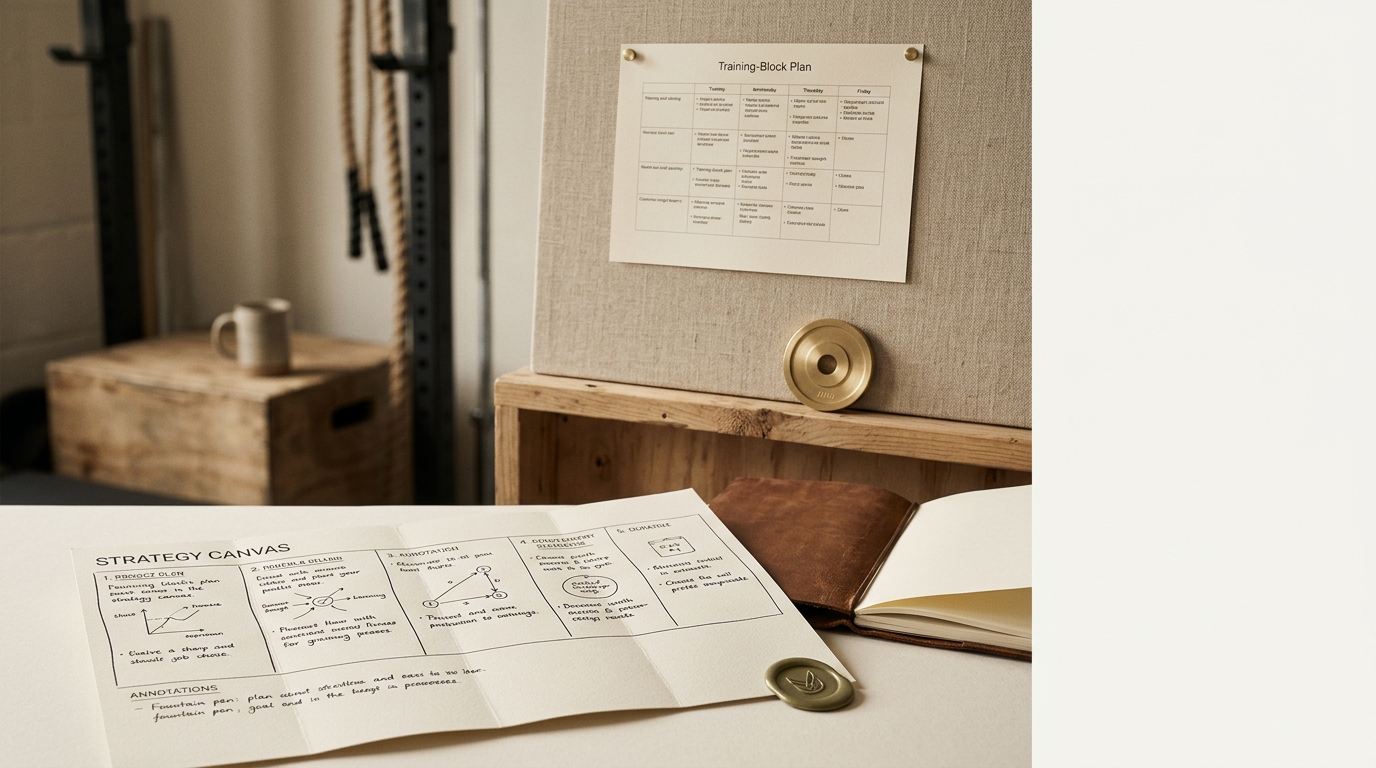
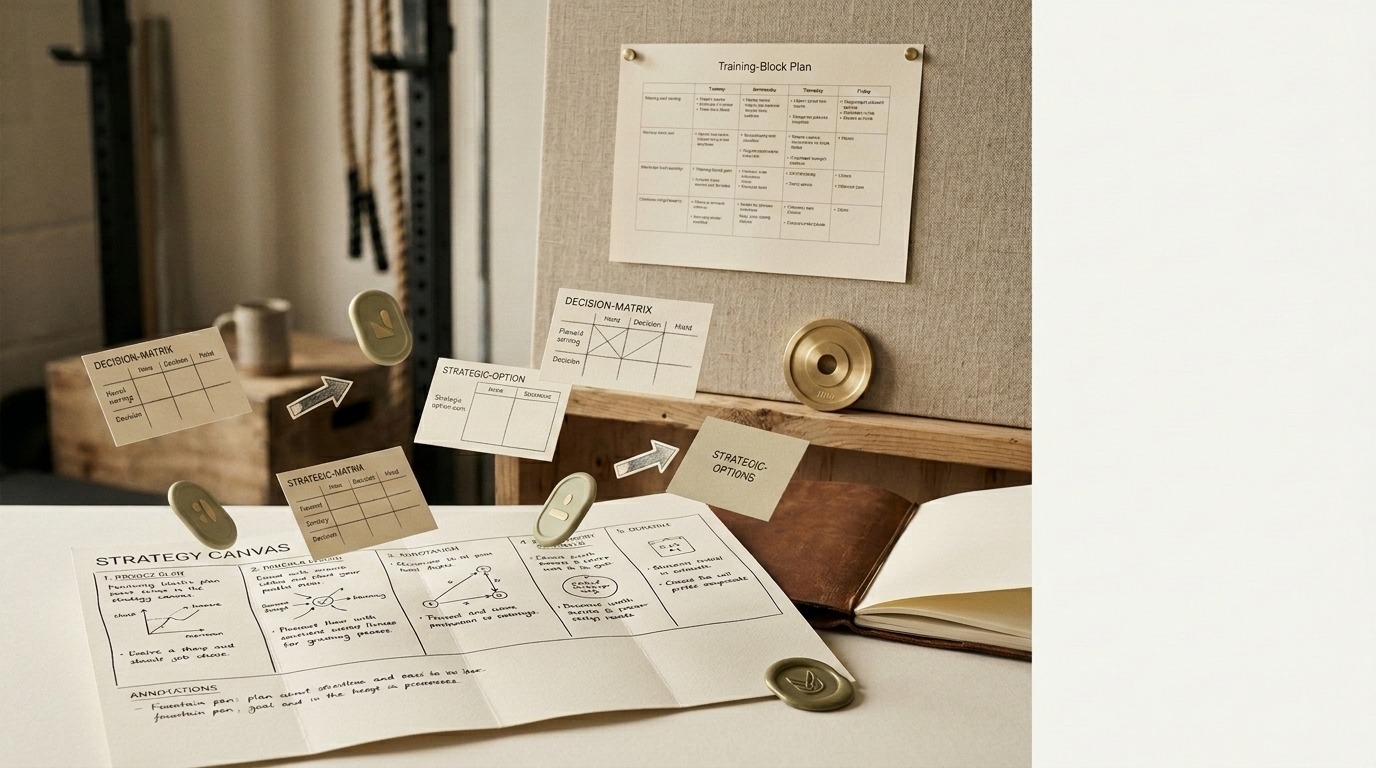
Strategy & Consultancy for Combat Sports & Fitness — The Practitioner’s Playbook.
A focused playbook for Combat Sports & Fitness operators running Strategy & Consultancy. Pre-event marketing that starts week-of costs 3x more than the same spend layered onto an 8-12 week warm audience. Athletes, broadcast brands, sponsors and members each need their own asset pipeline — one shared Dropbox folder doesn't scale.
Strategy & Consultancy for Combat Sports & Fitness is its own discipline.
Six things this playbook covers, end to end.
Written 90-day roadmap with deliverables, owners and KPIs
Tuned to Combat Sports & Fitness — the version we ship to operators in this vertical.
Quarterly OKRs with measurable success signals
Tuned to Combat Sports & Fitness — the version we ship to operators in this vertical.
Competitive map (positioning, pricing, channel mix)
Tuned to Combat Sports & Fitness — the version we ship to operators in this vertical.
Go-to-market brief per launch
Tuned to Combat Sports & Fitness — the version we ship to operators in this vertical.
Plain-English board pack with numbers + narrative
Tuned to Combat Sports & Fitness — the version we ship to operators in this vertical.
Quarterly stress-test of strategy against reality
Tuned to Combat Sports & Fitness — the version we ship to operators in this vertical.
SectionThe honest reframe most consultancies won't tell you
Generic consultancies sell gym owners a pre-printed strategy deck. Vision, mission, values, four pillars, eighty slides, forty-grand invoice. The deck reads the same whether the client runs a 4,000 sq ft boxing gym in Manchester or a £180-a-month yoga studio in Putney — because the consultancy never went deeper than "fitness sector, post-pandemic recovery, wellness tailwind." Then they wonder why the gym's margin keeps compressing every January as discounted memberships eat the floor and the head coach threatens to walk to the studio across the road.
Combat sports and fitness is not "the gym industry" at the strategy level. It is a stack of distinct revenue lines — base memberships, personal training, semi-private coaching, group programmes, retail and merch, corporate partnerships, kids' classes, gradings and gradings-fees on the martial-arts side — each with its own margin profile, churn curve, coach-cost structure, and customer acquisition cost. A strategy deck that does not separate them is a deck that cannot be acted on. A consultant who has not modelled the difference between an £85-a-month standard member at 14-month tenure and a £220-a-month PT-bundle member at 31-month tenure — or the difference between a salaried head coach and a 60/40-split contracted PT — is not advising you. They are renting you a logo.
This playbook fixes the structure. Mix economics is the lens. Churn-aware unit economics is the lever. Productised memberships, coach retention, and class-utilisation discipline are the compounders. Read it, run it yourself, or have us ship it on retainer.
SectionThe eight-point audit we run on day one
Score your own commercial strategy red / amber / green this week.
- Members vs PT vs merch — mix economics — A documented split of revenue, gross margin, and contribution by line: base memberships, PT, semi-private, group programmes, kids' classes, retail, gradings, corporate. Most operators we audit can quote total revenue but cannot break gross margin by line, which means they have no idea whether the merch wall is a profit centre or a stockroom subsidy, or whether PT is actually carrying the floor or just looking busy on the schedule.
- Churn-aware unit economics (LTV / churn / acquisition cost) — A live model of monthly churn, average tenure, lifetime value, and customer acquisition cost — split by membership tier and by acquisition channel. Combat-sports gyms typically run 4–7% monthly churn at the base tier and 1.5–3% at the PT-bundle and grading-track tiers; LTV doubles or triples once the member is on a structured progression. Operators who cannot quote those numbers cannot price, cannot budget acquisition, and cannot defend renewal pricing in January.
- Multi-location expansion vs licensing the brand — A modelled choice between own-and-operate expansion and licensing the brand and curriculum to operator-partners. Own-and-operate captures full margin and full brand control at high capex (£180k–£400k fit-out, 9–18 month payback). Licensing trades margin per site for capital-light geographic spread and a recurring royalty stream. Most combat-sports operators expand by accident — opening site two because a head coach asked for a bigger room — instead of by deliberate model choice.
- Coach acquisition and retention strategy — A documented strategy for hiring, retaining, and exiting coaches and PTs, with named compensation models (salary, hourly, rev-share, 60/40 PT split, hybrid), career pathway, qualifications support (REPs, CIMSPA, England Boxing, IBJJF affiliations, yoga teacher training continuation), and a written non-compete and member-non-solicit. Coach churn is the silent margin destroyer: a head coach walking with thirty PT clients is a £60k–£90k annual revenue hit that no marketing budget can refill in a quarter.
- Productisation of memberships (single / group / family / corporate) — A productised membership architecture covering individual, family/joint, group/team, corporate-partnership, and concession (student, NHS, military, emergency services). Each productised tier has documented inclusions, exclusions, peak/off-peak access, and an upsell path. Most operators we audit run two undifferentiated tiers (monthly and annual) and wonder why average revenue per member sits at £79 instead of £128.
- Pricing-pack architecture (entry / standard / premium) — A three-tier pricing pack with documented inclusions, exclusions, and upsell triggers. Entry wins the price-shopper at the lowest sustainable margin and seeds the funnel. Standard is the 65% conversion target. Premium bundles unlimited classes, one or two PT sessions a month, gradings or progression coaching, app-based programming, kit credit, and priority booking — and runs at 40–60% gross-margin uplift over entry. Without tiered packs, every joining conversation is a price negotiation. With packs, the front-of-house team is selling a configuration.
- Class-utilisation maximisation — A live model of class utilisation by time slot, instructor, and product line, with capacity targets and a published rebalancing cadence. Combat-sports and fitness operators leak the most margin in the off-peak shoulders (10am–4pm weekdays, late evenings on weekends) where a half-empty class costs the same in coach-time and rent as a full one. The strategic move is not "more classes" — it is utilisation discipline: cut, merge, or repurpose any slot under 55% sustained utilisation, and protect the 80%+ slots with capacity-cap pricing.
- Exit / EBITDA multiples positioning — A documented read of where the business sits on the buyer's spreadsheet: trailing-twelve-month EBITDA, recurring-revenue percentage, churn rate, location count, brand defensibility, coach dependency, and the implied multiple band (4–5x for owner-dependent single-site; 6–8x for productised multi-site; 9–12x for licensed/franchised brand systems with recurring royalties). Most owners discover at exit that the buyer's multiple is half what they expected — because nobody told them coach-dependency, undocumented systems, and a churn rate above 6% destroy the multiple.
Three or more reds — fix the strategic foundation before any new spend or hiring.
SectionSix productised deliverables we ship per cycle
Members vs PT vs merch — mix economics review. A written commercial-mix document that decomposes revenue, gross margin, and contribution by line: memberships, PT, semi-private, group programmes, kids', retail, gradings, corporate. Includes a recommended portfolio mix per gym format (combat-sports box, multi-discipline, boutique, F45-style HIIT, yoga / Pilates studio, hybrid PT-led), the deliberate lines to grow, and the lines to exit. Time to first signal: 30 days. Owned by you, exported as a written board paper.
Churn-aware LTV unit economics. A live unit-economics model covering monthly churn, average tenure, LTV, and CAC — split by membership tier, acquisition channel, and cohort. Includes a written cohort-retention curve, a CAC payback calculation per channel, and a quarterly review trigger. The tool that finally lets you set marketing budget by channel ROI instead of by gut, and that makes the January renewal pricing conversation a numbers conversation instead of a fight. Time to first signal: 45 days, with the second cohort renewal as the proof point.
Multi-location vs licensing model. A modelled comparison of own-and-operate expansion versus licensing the brand and curriculum, with capex, payback, royalty economics, and brand-control trade-offs. Includes a 24-month phased plan for whichever model wins the analysis: site selection, fit-out budget, coach pipeline, and break-even modelling for own-and-operate; licensee profile, curriculum-pack architecture, royalty rate, support structure, and territory rights for the licensing alternative.
Coach acquisition and retention strategy. A written coach strategy covering hiring sources (qualified pipeline from REPs / CIMSPA / England Boxing / yoga teacher training schools), compensation architecture by role, written career pathway, retention triggers, non-compete and non-solicit clauses, and the member-handover protocol when a coach exits. Includes a coach-economics model (salary vs hourly vs rev-share vs 60/40 PT split) with utilisation breakeven points and a recommended hiring sequence.
Membership productisation. A documented productised architecture covering individual, family / joint, group / team, corporate-partnership, and concession tiers. Each productised tier has written inclusions, exclusions, peak / off-peak access, freeze and pause rules, upsell triggers, and a default conversion path. Includes a three-tier entry / standard / premium overlay and a quarterly review trigger linked to class-utilisation data.
Class-utilisation maximisation playbook. A live class-utilisation model and rebalancing playbook, with weekly utilisation by slot and instructor, a documented cull / merge / repurpose decision tree for under-55% slots, and a capacity-cap pricing rule for 80%+ slots. Includes the seasonal calendar overlay (January surge, summer dip, September re-engagement, November pre-Christmas push) and the timetable rebuild cadence. The strategic shift from "more classes will solve it" to utilisation discipline.
SectionWhat to do this week
Three actions, ranked by leverage.
- Decompose last quarter's revenue and gross margin by line. Owner: founder or finance lead. Time: 90 minutes. Pull the last 90 days of revenue, split by line (base membership, PT, semi-private, group, kids', retail, gradings, corporate), and calculate gross margin (revenue minus direct coach cost, kit cost, and floor allocation). If you cannot do this in 90 minutes, the strategic problem is upstream of strategy — you are running a multi-line business without a line P&L. Fix that first.
- Run a 12-month cohort retention curve on your base members. Owner: founder or membership lead. Time: 60 minutes. Pull a representative joining cohort from twelve months ago and chart how many remain at month 1, 3, 6, 9, and 12. The shape of that curve tells you whether your problem is onboarding (steep month-1 drop), engagement (steady month-3 to month-6 leak), or pricing fatigue (month-9 cliff at the renewal anniversary). Each shape demands a different strategic response.
- Decide DIY, DWY or DFY for the next 90 days. Owner: founder. See the three ways.
SectionFive questions combat-sports and fitness operators ask us about strategy
What's the right revenue mix between memberships, PT, and merch? For a productised combat-sports or multi-discipline gym in the £400k–£1.8m revenue band, the disciplined operators we coach run roughly 55–65% base memberships, 25–35% PT and semi-private, 5–10% retail / merch / kit, and a small but high-margin 3–6% gradings, programmes, or corporate partnerships line. Yoga / Pilates and boutique HIIT studios skew further toward memberships (70–80%) with a thinner PT line, because the format favours group economics over one-to-one. The mix is not the strategy — the strategy is the deliberate productisation that produces the mix. Operators who chase PT revenue without first productising the membership floor end up running a glorified PT studio with a depreciating gym attached.
What does churn-aware LTV math actually look like? Take a representative cohort and chart monthly retention out to month 18 or 24. A typical combat-sports box at the base tier runs 4–7% monthly churn, which compounds to roughly 14–18 months average tenure; at £85/month, that is £1,200–£1,500 LTV. The PT-bundle and grading-track tiers run 1.5–3% monthly churn and average 28–40 months tenure; at £180–£220/month, LTV moves to £5,000–£8,800 — four to seven times the base. That math tells you exactly where to spend acquisition: if your CAC is £140 and your base LTV is £1,200, you have headroom to acquire aggressively; if your CAC creeps to £280 because you're competing on Google Ads against the budget chain down the road, you need to shift the acquisition mix to referral, community, and gradings-track funnels where CAC is structurally lower.
Should we expand by opening site two or by licensing the brand? Own-and-operate wins when you have a productised system, a coach pipeline, and £180k–£400k of capex appetite per site, and you want to capture the full margin and full brand control. Licensing wins when the brand has earned recognisable territory equity (typically after three to five years of consistent operation), the curriculum and SOPs are documented to the point another operator could deliver them, and you would rather take 6–10% royalties on £600k–£1m of licensee revenue per site than carry the operational and capex weight. The wrong move is opening site two before the systems and SOPs are documented — you double the surface area of the founder problem, the coach problem, and the cash problem in one decision.
How do we keep our head coach from walking with half our PT clients? Three structural moves, in this order. First, productise the floor so members are buying the gym brand and the gym programme, not the individual coach — that is what halves the coach-dependency hit when a coach exits. Second, write the compensation architecture, career pathway, and non-compete / non-solicit into every coach contract from day one (not as a retention scramble after a coach gives notice); the disciplined operators we coach use a 60/40 PT split with a clear in-house referral upgrade path, salary-plus-bonus for head-coach roles, and a 12-month non-solicit on members. Third, build a second-line bench — at least one coach trained, accredited, and known to members for every primary discipline you run — so the gym is never one resignation away from a programming hole.
Can we run this ourselves with the playbook + £750 audit? Yes. The strategy work is achievable in-house if you have a founder who will own it, a finance lead or accountant who can pull line-level P&L, and the discipline to spend a structured day per quarter on the strategic review. The £750 audit gives you a written red/amber/green of all eight points, a prioritised next-step list with named owners and dates, and the cohort-retention template, mix-economics worksheet, and three-tier pricing-pack template. Credit toward first cycle if you sign for DWY/DFY within 30 days.
SectionWhere to go from here
If you want this shipped end-to-end on a productised retainer, book a 30-minute discovery call.
If you'd rather have a senior practitioner reviewing your team's strategic decisions and quarterly reviews, the coaching plans start at £750/month with rolling cycles and walk-away rights. If you have a hard window — the January membership surge, a new-class or new-discipline launch, a planned site-two opening, a re-pricing rebuild ahead of a renewal cohort — the two-week embedded sprint lands a senior practitioner inside your strategy team for ten working days at £3,000 fixed, sharply scoped to January-window strategy or new-class launches.
Or run it yourself. Eight-point audit + one strategic deliverable per quarter + twice-quarterly office hours.
Get Strategy & Consultancy for Combat Sports & Fitness.
A focused, no-fluff playbook covering the audit, the deliverables, the success signals and the cadence we use when we run this combination for clients. Combat Sports & Fitness-specific from the first page to the last.
No spam. One playbook, one follow-up email a week later asking what landed and what didn’t. Unsubscribe in one click.
Where the playbook ends and the engagement begins.
The framework, free
- The eight-point audit baseline so you can score your own site this week
- The six productised deliverables we ship per cycle, named and explained
- The 30/60/90 fix roadmap so you can plan internal capacity
- The three-way model (DIY / DWY / DFY) and price bands
- The success metrics we track and the time-to-signal canon
- The industry-specific regulators, sub-verticals and trust signals
What requires the call
- Named-client case studies with revenue numbers (NDA-protected)
- Our internal tooling stack and platform vendors (trade-secret)
- The proprietary scoring rubric we use to triage problems
- Specific commercial terms beyond published price bands
- Direct introductions to our partner network
- The post-engagement playbook revisions we ship per cycle
Adjacent combinations operators in this vertical also read.
Strategy & Consultancy for Personal Brands & Creators
A focused playbook for Personal Brands & Creators operators running Strategy & Consultancy.
Open the playbook → PLAYBOOKStrategy & Consultancy for Health & Wellbeing
A focused playbook for Health & Wellbeing operators running Strategy & Consultancy.
Open the playbook → PLAYBOOKSocial Media Management for Combat Sports & Fitness
A focused playbook for Combat Sports & Fitness operators running Social Media Management.
Open the playbook → PLAYBOOKDigital PR & Reputation for Combat Sports & Fitness
A focused playbook for Combat Sports & Fitness operators running Digital PR & Reputation.
Open the playbook →Start your Strategy & Consultancy for Combat Sports & Fitness programme.
Thirty-minute discovery call, free, no commitment. We’ll send a tailored band before the call and a written proposal within two business days.