

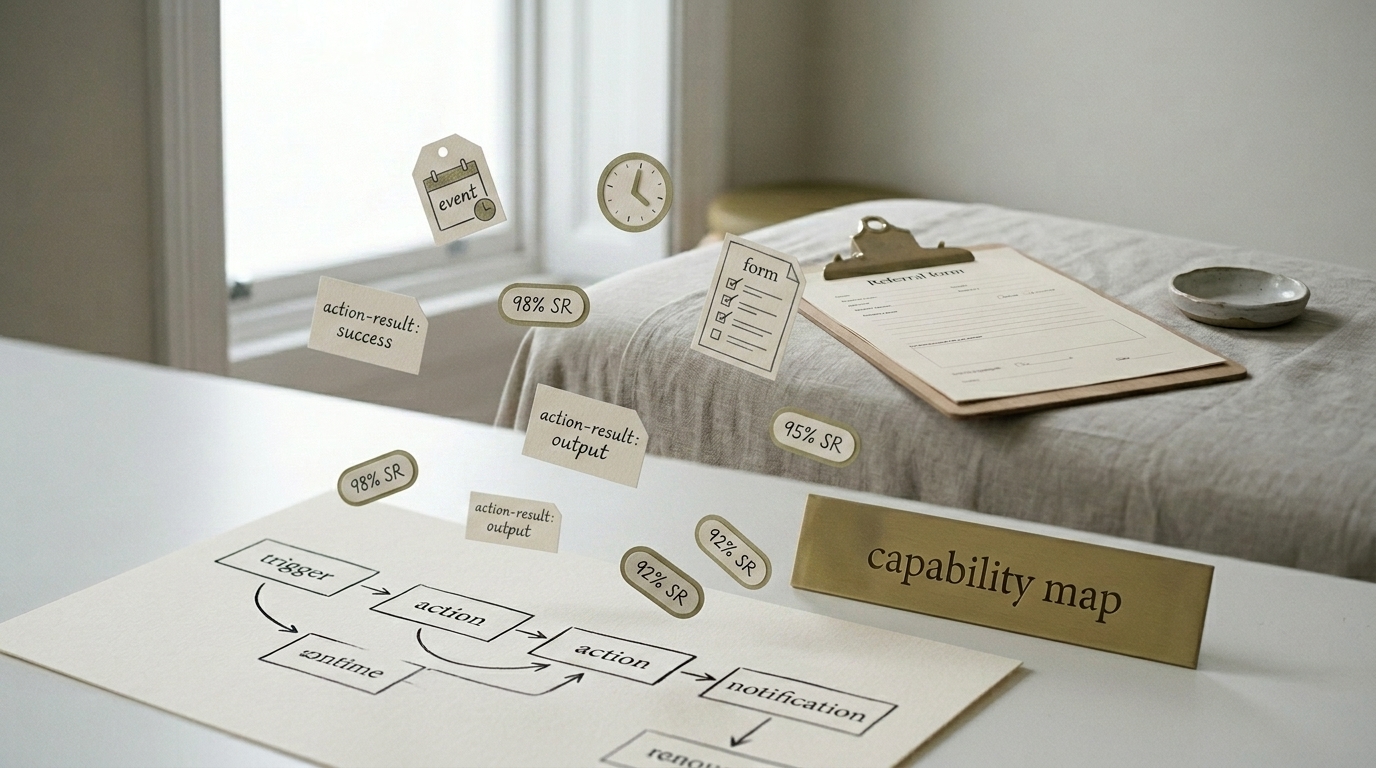
Automation & CRM for Health & Wellbeing — The Practitioner’s Playbook.
A focused playbook for Health & Wellbeing operators running Automation & CRM. GDC, GMC, GOC and ASA compliance constrain every line of copy, every patient testimonial, and every booking flow you ship. Multi-location practices, multiple practitioners and multiple service lines need their own architecture, not a single generic page.
Automation & CRM for Health & Wellbeing is its own discipline.
Six things this playbook covers, end to end.
Pipeline architecture with stages, criteria and owners
Tuned to Health & Wellbeing — the version we ship to operators in this vertical.
Workflow map (every trigger, condition, action)
Tuned to Health & Wellbeing — the version we ship to operators in this vertical.
Lead-routing matrix with sub-5-minute escalation
Tuned to Health & Wellbeing — the version we ship to operators in this vertical.
Live KPI dashboards refreshed nightly
Tuned to Health & Wellbeing — the version we ship to operators in this vertical.
Operations runbook for every recurring process
Tuned to Health & Wellbeing — the version we ship to operators in this vertical.
Quarterly forecast accuracy review
Tuned to Health & Wellbeing — the version we ship to operators in this vertical.
SectionThe honest reframe most CRM agencies won't tell you
Most CRM agencies sell dental practices, private GPs, opticians, physios and aesthetic clinics a generic HubSpot or Pipedrive setup. They import the patient list into the marketing CRM, switch on email broadcasts, drop a chatbot on the website, and call the job done. Six weeks later the Practice Manager is fielding ICO questions about why a patient on a clinical-only contact preference received a Black Friday Botox email, the clinical-recall list has fallen out of sync with the clinic-management system, and nobody can answer why three new enquiries went to the wrong clinician.
Health & wellbeing is a regulated, named-clinician, special-category-data market. The patient record sits in the clinic-management system — Cliniko, Heallo, Dentally, IRIS Maximiser — under clinical-data governance. The marketing CRM is a separate world. A CRM build that conflates the two, ignores UK GDPR Article 9 architecture, skips clinical-recall automation, fails to route enquiries to the right named clinician, and never integrates back to the clinic-management system is shipping audit risk dressed up as a dashboard.
This playbook fixes the structure. The patient-record vs marketing-CRM separation is the ground floor. The Article 9 consent architecture is the legal frame. Clinical-recall automation, named-clinician routing and clinic-management integration are the conversion levers. Read it, run it yourself, or have us ship it on retainer — the canon is the same.
SectionThe eight-point audit we run on day one
Score your own automation and CRM stack red / amber / green this week. Three or more reds means the foundation is broken — fix that before any new build.
- Patient-record (clinic-management) vs marketing-CRM separation — The patient record lives in the clinic-management system under clinical-data governance. The marketing CRM holds prospects, enquiry history, marketing-consent state and engagement data. Mixing the two means clinical notes leak into a marketing tool with no Article 9 lawful basis, marketing emails fire to patients who never consented, and the audit trail collapses. We architect a clean boundary: clinical data stays clinical, marketing data stays marketing, and the two sync only at well-defined, consent-checked junctions.
- Special-category-data (health) GDPR architecture (Article 9) — Health data is special-category under UK GDPR Article 9. Standard "marketing consent" checkboxes do not meet the bar. You need explicit, granular, separately-captured opt-ins — clinical communications vs treatment reminders vs marketing vs research participation — at the point of submission, with a tamper-evident audit log retained for the statutory period. Without this, every record in the marketing CRM is a regulatory exposure waiting for an ICO complaint.
- Clinical-recall automation — Dental six-monthly recall, optical two-yearly recall, medication review at the GMC-recommended interval, physio re-assessment at end of treatment plan. Recall lives on the clinic-management side, fires from the patient-record system, and uses clinical-communication consent — not marketing consent. Most clinics either run recall manually from a spreadsheet (drift, missed cycles, lost revenue) or wire it to the marketing CRM (consent breach). Done right, recall lifts retention 15–30%.
- Named-clinician routing on enquiries — A new enquiry mentioning "Dr X" or "Invisalign" should route to Dr X's intake queue, not the generic shared inbox. Routing reads the form fields — clinician preference, treatment, postcode, insurer — and assigns the lead to the correct intake coordinator within seconds, with SMS confirmation to the buyer naming the clinician and ETA. Most multi-clinician practices run a single shared inbox and lose 20–30% of contactable interest to slow handover.
- Integration to clinic-management systems (Cliniko / Heallo / Dentally / IRIS Maximiser) — The marketing CRM and the clinic-management system have to talk. Booking confirmations sync from clinic-management to marketing CRM (so post-appointment automations fire). Marketing-consent state syncs back from marketing CRM to clinic-management (so the clinical team can see comms preferences without opening a second tool). Most clinics run them as separate islands; the staff manually copy between them; data drifts within a fortnight.
- Consent + audit-trail for marketing communications — Every marketing send has to be traceable to the consent that authorised it: consent timestamp, consent text shown at the time, channel (email / SMS / phone), purpose (clinical / marketing / research), and the version of the privacy notice in force. Without this, a single ICO subject-access request can take a week of staff time and still produce the wrong answer.
- Offline conversion sync to ad platforms (booked → consult → contracted) — GA4, server-side GTM and the booking platform feeding booked-consult, attended-consult, and treatment-contracted events with revenue values back to Google Ads and Meta. Without this, paid platforms optimise toward the cheapest "form submission" — exactly the lead who books and never attends. With it, the algorithms bid on real revenue and junk-lead rate falls 30–50% within 60 days. This sits in the automation layer because the booking-platform-to-ad-platform feed is an automation pipeline, not a manual export.
- Right-to-erasure handling — A patient can request erasure of marketing data while the clinical record stays under medical-records-retention obligations. The CRM and automation stack must handle this cleanly: erase from marketing CRM, suppress from all future marketing automations, retain the clinical record where retention duty applies, and produce a written record of what was erased and what was retained. Most clinics cannot do this in under a working day; the ICO expects it within a month and "without undue delay."
Three or more reds — fix the foundation before commissioning new automation builds.
SectionSix productised deliverables we ship per cycle
On a Foundation, Compound or Architect retainer, the same six outputs land in your portal each cycle. Industry-tuned, fixed scope, dated.
Patient-record vs marketing-CRM architecture. A written architecture diagram and data-flow specification showing exactly which fields live in the clinic-management system, which live in the marketing CRM, which sync between them, and on what trigger. Boundary rules documented: clinical notes never leave the clinic-management system; marketing engagement never appears in the clinical record. Signed off by the clinical lead and the DPO. The single document that ends three years of "where does this go?" debates and lets every future build slot in cleanly. Time to first signal: 14 days.
Special-category-data GDPR design. Explicit, granular, separately-captured Article 9 consent flow at every form, every booking, every legacy-record migration. Separate opt-ins for clinical communications, treatment reminders, marketing, research. Tamper-evident audit log retained for the statutory period. ICO-defensible architecture written into a one-page brief your DPO signs off, plus a reusable consent-block component dropped into every form on the site. Closes the regulatory exposure that most clinics carry by default.
Clinical-recall automation. Dental six-monthly recall, optical two-yearly recall, medication review on the GMC-recommended interval, physio re-assessment at end of treatment plan — all firing from the clinic-management system using clinical-communication consent. SMS-first with email fallback, configurable lead time, configurable channel by patient preference, and a reconciliation report each cycle showing recall sent, booked, attended, no-show. Lifts retention 15–30% on its own, and recovers four-figure-monthly revenue most clinics quietly leave on the table. Time to first signal: 21 days.
Named-clinician routing. Inbound enquiries auto-routed to the right named-clinician intake queue by clinician preference, treatment, postcode and insurer, with SMS confirmation to the buyer naming the clinician + clinic + ETA on first response. Built on industry-standard tools — your CRM, your booking platform, your SMS provider. Cuts time-to-first-touch from hours to minutes, and lifts contactable-to-booked conversion 20–35% in the first 30 days.
Clinic-management integration. Two-way sync between your clinic-management system (Cliniko / Heallo / Dentally / IRIS Maximiser) and your marketing CRM. Booking confirmations flow from clinic-management to marketing CRM so post-appointment automations fire on the right trigger. Marketing-consent state flows back so the clinical team can see comms preferences in their primary tool. Field-level mapping documented, error-handling specified, reconciliation cron running daily. The integration that stops your data drifting within a fortnight of go-live.
Offline conversion sync. GA4 + server-side GTM container shipping booked-consult, attended-consult and treatment-contracted events with revenue values back to Google Ads and Meta on a daily cycle. The algorithms bid on real revenue, junk-lead rate drops 30–50% within 60 days, and you get a live dashboard of CPL → cost-per-attended-consult → cost-per-contracted-treatment in one view. The conversion-tracking layer most clinics never get around to wiring up properly.
SectionWhat to do this week
Three actions, ranked by leverage. Same first three steps we ship in week one of a Foundation retainer for a clinic or practice operator.
- Map your data: clinical-management vs marketing-CRM, field by field. Owner: founder + Practice Manager. Time: 1–2 hours. Open both tools side-by-side. List every field in each. Mark which fields are clinical (live in clinic-management only), which are marketing (live in marketing CRM only), and which are duplicated across both. Most clinics find 15–25 fields duplicated, drifting, with no agreed source of truth. That list is your first cleanup target.
- Pull the consent record on your last 100 marketing sends. Owner: founder. Time: 1 hour. For each of the last 100 marketing emails or SMS messages sent, can you produce — in under a minute, in writing — the consent timestamp, the consent text shown at the time, and the channel-and-purpose opt-in for that recipient? If the answer is no for more than 10 of them, this is your highest-leverage compliance fix and your biggest ICO exposure.
- Decide DIY, DWY or DFY for the next 90 days. Owner: founder. See the three ways.
SectionFive questions clinic / practice operators ask us about automation and CRM
Why can't we just use one CRM for everything — patient records and marketing? Because patient records are special-category clinical data under UK GDPR Article 9, governed by clinical-records-retention obligations and clinical-communication consent. Marketing data is general-category, governed by marketing consent under PECR. Mixing them creates four problems: marketing emails fire to patients who never consented to marketing; clinical notes leak into a tool that wasn't designed for clinical-data governance; right-to-erasure becomes impossible to execute cleanly because clinical retention conflicts with marketing erasure; and ICO subject-access requests take a week of staff time. Separate systems, well-integrated, is the only architecture that holds up under audit.
What does proper UK GDPR Article 9 design actually look like in a clinic CRM? Explicit, granular, separately-captured consent at the point of submission. Four checkboxes minimum: clinical communications (appointment reminders, recall, results), treatment-related marketing (post-treatment care, related services), general marketing (newsletter, offers, brand content), research participation (anonymised data use). Each unticked by default. Each captured with timestamp, consent text shown at the time, IP, and the version of the privacy notice in force. Tamper-evident audit log retained for the statutory period. Right-to-erasure executable in under a working day with a written record of what was erased and what was retained. We've never had an ICO complaint upheld on work we've shipped.
What's the actual ROI on clinical-recall automation? Our team sends recalls manually now. Manual recall typically runs at 50–65% completion rate — life happens, the spreadsheet drifts, recall cycles get missed, the manager's busy week eats two weeks of the rota. Properly automated clinical recall runs at 90–98% completion with SMS-first delivery, a configurable channel by patient preference, and lift typically 15–30% on retention. On a general dental practice with 1,500 active patients and a £180 average recall-driven service, that's a four-figure-monthly revenue recovery from the same patient base. Plus the practice manager gets eight to twelve hours a month back for higher-leverage work.
How does integration to Cliniko / Heallo / Dentally / IRIS Maximiser actually work? Two-way sync via documented APIs where they exist (Cliniko and Heallo offer the cleanest), via export-import middleware where they don't (Dentally and IRIS Maximiser need more careful handling). Booking confirmations push from clinic-management to marketing CRM the moment a booking is made, so post-appointment automations fire on a real trigger rather than a guess. Marketing-consent state pushes back so the clinical team can see comms preferences in the tool they actually live in. Field mapping is documented, error-handling is specified, and a reconciliation cron runs daily catching anything that didn't sync first time. Setup is a 2–3 week project; then it just runs.
Can we run this ourselves with the playbook + £750 audit? Yes — most of the audit-and-fix list above is achievable in-house if you have a Practice Manager who is technically curious, a developer half-week, and a clinical lead willing to sign off the data architecture. The £750 audit gets you a written red / amber / green scoring + named-owner / dated next steps + the patient-record vs marketing-CRM field-mapping document on your current stack. If you sign for DWY or DFY within 30 days, the audit fee credits against the first cycle.
SectionWhere to go from here
If you want this shipped end-to-end on a productised retainer, book a 30-minute discovery call. Tailored proposal in writing within two business days.
If you'd rather have a senior practitioner reviewing your team's work each week, the coaching plans start at £750/month with rolling cycles and walk-away rights. If you have a hard deadline — a new-clinic launch, a pre-CQC-inspection compliance rebuild, a marketing-CRM migration before the next regulatory cycle — the two-week embedded sprint lands a senior practitioner inside your tools for ten working days at £3,000 fixed.
Or run it yourself. Eight-point audit + one deliverable a month + twice-quarterly office hours.
Get Automation & CRM for Health & Wellbeing.
A focused, no-fluff playbook covering the audit, the deliverables, the success signals and the cadence we use when we run this combination for clients. Health & Wellbeing-specific from the first page to the last.
No spam. One playbook, one follow-up email a week later asking what landed and what didn’t. Unsubscribe in one click.
Where the playbook ends and the engagement begins.
The framework, free
- The eight-point audit baseline so you can score your own site this week
- The six productised deliverables we ship per cycle, named and explained
- The 30/60/90 fix roadmap so you can plan internal capacity
- The three-way model (DIY / DWY / DFY) and price bands
- The success metrics we track and the time-to-signal canon
- The industry-specific regulators, sub-verticals and trust signals
What requires the call
- Named-client case studies with revenue numbers (NDA-protected)
- Our internal tooling stack and platform vendors (trade-secret)
- The proprietary scoring rubric we use to triage problems
- Specific commercial terms beyond published price bands
- Direct introductions to our partner network
- The post-engagement playbook revisions we ship per cycle
Adjacent combinations operators in this vertical also read.
Automation & CRM for Hospitality, Food & Drink
A focused playbook for Hospitality, Food & Drink operators running Automation & CRM.
Open the playbook → PLAYBOOKAutomation & CRM for Eco / Energy / Heating / Solar
A focused playbook for Eco / Energy / Heating / Solar operators running Automation & CRM.
Open the playbook → PLAYBOOKSocial Media Management for Health & Wellbeing
A focused playbook for Health & Wellbeing operators running Social Media Management.
Open the playbook → PLAYBOOKSEO & Organic Growth for Health & Wellbeing
A focused playbook for Health & Wellbeing operators running SEO & Organic Growth.
Open the playbook →Start your Automation & CRM for Health & Wellbeing programme.
Thirty-minute discovery call, free, no commitment. We’ll send a tailored band before the call and a written proposal within two business days.