
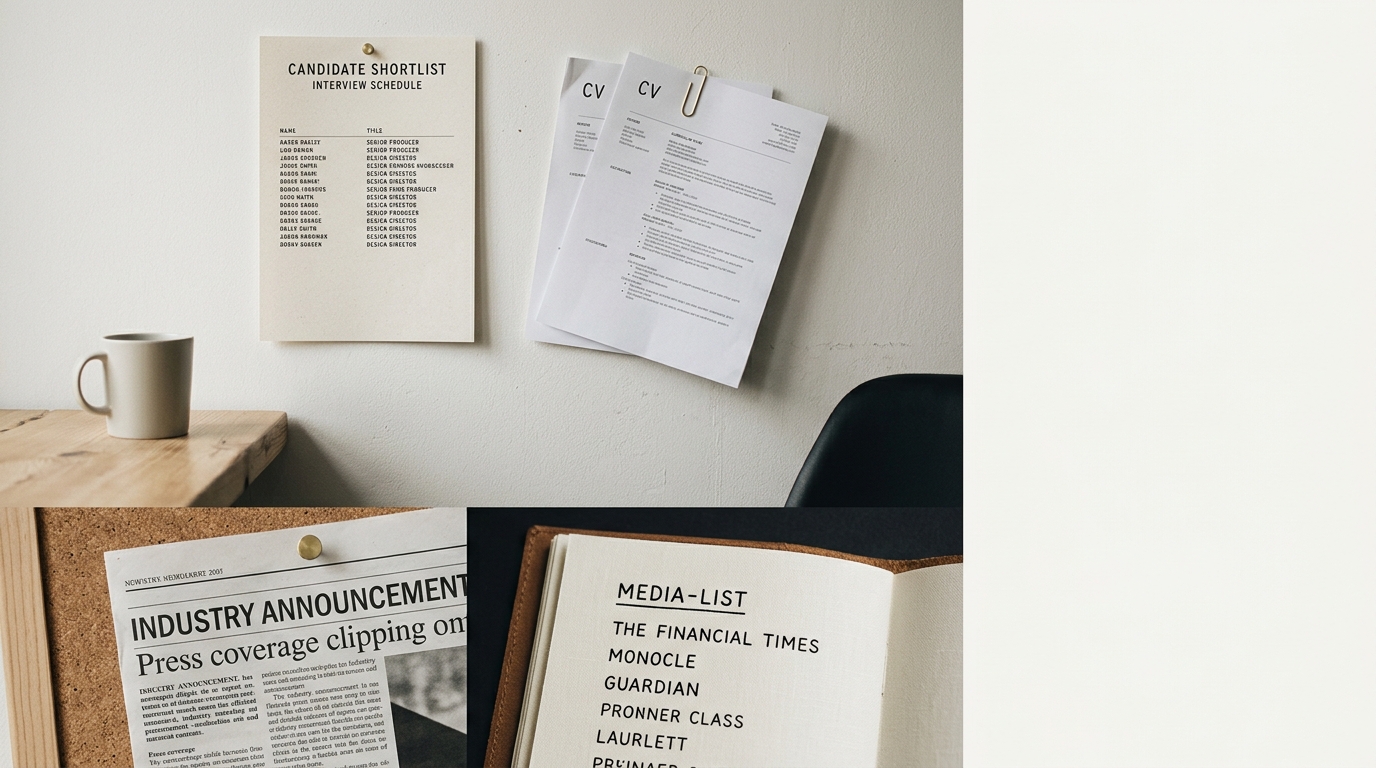

Digital PR & Reputation for Recruitment & Careers — The Practitioner’s Playbook.
A focused playbook for Recruitment & Careers operators running Digital PR & Reputation. Job-board-only acquisition produces commodity candidates at premium cost — employer brand is the only sustainable lever. Per-role landing pages with realistic job previews and pay transparency double the application rate at half the cost-per-hire.
Digital PR & Reputation for Recruitment & Careers is its own discipline.
Six things this playbook covers, end to end.
Story bank with angles, data and quotes
Tuned to Recruitment & Careers — the version we ship to operators in this vertical.
Targeted media list with named editors and beats
Tuned to Recruitment & Careers — the version we ship to operators in this vertical.
Pitch templates per outlet with subject-line variants
Tuned to Recruitment & Careers — the version we ship to operators in this vertical.
Outreach calendar with follow-up rules
Tuned to Recruitment & Careers — the version we ship to operators in this vertical.
Backlink scorecard (domain rating + anchor variation)
Tuned to Recruitment & Careers — the version we ship to operators in this vertical.
Reputation dashboard (review velocity, sentiment, branded search)
Tuned to Recruitment & Careers — the version we ship to operators in this vertical.
SectionHonest reframe
Most PR agencies sell recruiters a generic press distribution package — a 400-word release about a new hire or a fluffy "diversity in tech" angle, blasted to a syndication wire, followed by a screenshot of "180 publications picked it up" where 178 of them are zero-traffic press portals nobody reads. Then they bill £2,500 a month and wonder why the BD pipeline never moves and the consultants stop forwarding the coverage to candidates.
Recruitment PR is not "send a release to a wire and hope." It is a trade-press, salary-survey-led, consultant-positioning, reputation-defended discipline. The journalists who actually move the needle for a contingent agency, exec-search firm, RPO, or staffing business write at Recruiter, Recruitment Grapevine, Personnel Today, The HR Director, HR Magazine, People Management, and the careers / employment desks at the FT, Times, Telegraph, and Guardian. They do not respond to PR-wire spam. They respond to salary-survey data — the canonical link magnet of this category — to consultant commentary on sector-specific market conditions, to IR35 / employment-law / AWR analysis from a named expert, and to placement-story angles that humanise a deal flow most readers never see.
The other half of the brief is reputation. Glassdoor, Trustpilot, and Google reviews are where 60%+ of candidates and 40%+ of clients land before they engage. A negative consultant review left unanswered for two weeks costs more in lost mandates and lost candidate registrations than any single PR placement earns. This playbook fixes both halves — outbound PR and inbound reputation — and shows you how to run them in-house, with a coach, or on retainer.
SectionEight-point audit
Score each point red / amber / green this week.
- Trade-press relationship list — Recruiter / Recruitment Grapevine / Personnel Today / HR Director. A live, maintained list of at least twelve named editors and journalists across Recruiter, Recruitment Grapevine, Personnel Today, The HR Director, HR Magazine, People Management, Onrec, and the careers / employment desks at the FT, Times, Telegraph, and Guardian. Pitch history, last-contact dates, beat preferences (contingent vs exec vs RPO vs in-house TA), and whether they take exclusives. Most agencies have zero of this and are guessing every time they pitch.
- Salary-survey-led press placement programme. A twice-yearly salary-and-rates survey, sector-specific or function-specific to your desks, with at least 300 respondents per cycle, methodology disclosed, year-on-year comparators, and embargoed release windows. The single highest-converting link magnet in this category — trade press syndicates it, national press cherry-picks it, and the data set seeds twelve months of secondary stories. If you do not run a salary survey, you are leaving the canonical PR asset of the category on the table.
- Consultant + sector-specialist commentary positioning. At least three named consultants on your desks listed in trade-press contributor databases, with one published commentary piece per quarter on their vertical (life sciences hiring trends, fintech compensation, public-sector AWR pressures, contractor IR35 status). LinkedIn profiles aligned, contributor pages on relevant publications, headshots consistent. Most agencies undersell the consultants and pitch under the firm name only — which the press cannot quote and which never builds a personal brand a candidate would follow.
- Glassdoor / Trustpilot / Google review-velocity programme. Glassdoor score of 4.0+, Trustpilot score of 4.5+, Google score of 4.6+, with review-velocity targets tracked monthly. Active claim and response on every public-review platform you appear on, including the smaller niche ones (RateMyAgency, Indeed reviews, sector-specific platforms). One unclaimed listing on a 200-review platform is a slow leak that compounds for years.
- HARO / Connectively / journalist-platform monitoring for recruiter expert commentary. A daily-monitored inbox for journalist source requests on hiring trends, salary movements, IR35, contractor markets, candidate experience, employer branding, and labour-market data. Response SLA of under 4 hours during the working day, under 24 hours otherwise. Each response a tight 150-word answer with a named consultant, a credentials line, and a sector-specific data point. Most agencies either do not monitor or respond too late.
- IR35 / employment-law / AWR crisis-comms readiness. A written holding statement, a named spokesperson rota, and a pre-cleared legal-review pathway for the four most likely crises — an IR35 status determination challenge that hits the press, an AWR / Conduct Regulations enforcement action, a discrimination or bullying allegation against a consultant, a candidate-data breach. Most agencies have nothing on the shelf and improvise badly under pressure, then have to retract a comment a week later. A 48-hour holding statement written in advance is worth ten on-the-fly.
- Placement-story press programme with consent. A pipeline of placement stories — candidate-side and client-side — with written consent at offer-acceptance stage to use anonymised or named details for press, case studies, and LinkedIn. Trade press loves a real placement angle, particularly in exec search and senior contingent, because it humanises a category most readers never see inside. Most agencies leave consent collection until the story is needed, which is six months too late.
- LinkedIn-led PR distribution. Each press placement amplified within 24 hours by the named consultant or commentary spokesperson on LinkedIn, the firm page, and the relevant desk leaders, with sector-tagged copy and a comment-prompt question. LinkedIn is where 80% of the readership of a recruitment trade-press story actually consumes it; if you do not amplify, you are leaving the second-order distribution of every placement on the table.
Three or more reds — fix the foundation before any wire-distribution spend.
SectionSix deliverables
Trade-press relationship building. A six-month outreach programme into Recruiter, Recruitment Grapevine, Personnel Today, The HR Director, HR Magazine, People Management, Onrec, and the careers / employment desks at the FT, Times, Telegraph, and Guardian. Named-editor introductions, beat-aligned pitches, exclusives where appropriate, follow-ups at 7 and 14 days. Output: monthly placement-tracker reporting with reach, link metrics, and quote-pull-through. Real trade-press relationships compound — a journalist who has used your consultants twice will come to them third without prompting, particularly on time-sensitive market-condition stories where the deadline is hours not days. Time to first signal: 30-60 days for first placement, 90 days for sustained inbound enquiry.
Salary-survey-led press placement. The canonical recruitment PR asset, run as a twice-yearly programme. Survey design, distribution to your candidate and client database, third-party respondent boost where needed, 300+ respondents per cycle, methodology disclosed, year-on-year and region-by-region cuts, plus a sector or function deep-dive. Output: a flagship report (PDF and microsite), a press release timed to a trade-press window, an exclusive offer to one tier-one publication, secondary stories and regional cuts seeded over the following 90 days, and a year-round pipeline of derivative angles every time a related news event breaks. Survey reports are also the strongest link magnet in this category — trade press, HR blogs, in-house TA functions, and university careers services all link to them, building authority for the firm domain over years. Time to first signal: 90-120 days from survey design to first placement; 12-month link-equity build is the real prize.
Consultant commentary positioning. A 12-month programme to position three to six named consultants as quotable experts in their verticals. Contributor-page setup on Recruiter, Recruitment Grapevine, Personnel Today, and HR Magazine. LinkedIn rebuild for each named consultant, including pinned commentary, sector-tagged content cadence, and a fortnightly thought-piece. HARO / Connectively monitoring tied to each consultant's specialism. Output: monthly published-piece count, monthly quoted-mention count, monthly LinkedIn engagement and follower growth, and a quarterly review of consultant-led inbound BD enquiry. Time to first signal: 45-75 days for first contributor-page placement; 6 months for inbound enquiry attributable to consultant brand.
Review-velocity programme — Glassdoor, Trustpilot, Google. Monthly active management of Glassdoor, Trustpilot, Google, Indeed, and any sector-specific review surface you appear on. Listings claimed, profiles complete, brand assets uploaded, response cadence consistent. Monthly velocity target of 10-25 reviews per platform, depending on placement throughput. Glassdoor specifically engineered — leaver and joiner cadence, balanced response rate, named-leadership engagement on contested reviews. Output: monthly reputation dashboard with star average, review velocity, response rate, and named-consultant mention rate. Time to first signal: 30 days for response cadence, 90-120 days for visible average-star uplift.
IR35 / employment-law crisis comms. A pre-built crisis library covering the four most likely scenarios — IR35 status determination challenge in the press, AWR / Conduct Regulations enforcement, discrimination / bullying allegation against a consultant, candidate-data breach. Each scenario with a holding statement, a 48-hour spokesperson playbook, a legal-review pathway, a named-counsel contact, and a media-monitoring trigger threshold. Output: a written manual, a quarterly tabletop exercise, and a 24-hour SLA for first holding statement when a real incident lands. Pre-built crisis comms turns a category-killer event into a manageable 72-hour news cycle.
Placement-story press programme. A pipeline of placement stories built off consented candidate and client placements — exec search wins, senior contingent placements, RPO scale-up case studies, contractor-to-permanent conversions, hard-to-fill role narratives. Each story with on-the-record consent at offer-acceptance stage, a named consultant quote, a client-side quote where possible, and a forward-looking commentary on what the placement signals about the market. Output: 8-12 placement-led stories per cycle, seeded into trade press as feature material and into national careers desks as case-study anchors. Placement stories convert at multiples of opinion-led PR because they are the only category-true narrative most journalists cannot get from anyone else.
SectionWhat to do this week
Three actions, ranked by leverage.
- Audit your top three review platforms. Owner: founder, MD, or marketing manager. Time: 20 minutes. Open Glassdoor, Trustpilot, and Google. Note your current star average, total review count, and the date of your most recent owner response. Count any 1- or 2-star reviews left without a public reply. If you have any unclaimed listings on a 50+ review platform, claim them today. Glassdoor and Indeed need a separate employer-account claim — do both.
- Pull one salary-or-rates story candidate from your last 90 days of placement data. Owner: marketing manager or operations lead. Time: 45 minutes. Run a query on placement fees, contractor day rates, or salary offers across your top-performing desks for the last 90 days. Find one number — average uplift on permanent moves, day-rate movement on a contractor specialism, time-to-offer in a hot vertical, or counter-offer rate in a candidate-short market. Draft a 200-word commentary with the headline statistic and one chart. That is the seed of your first trade-press pitch and the proof-of-concept for the bigger salary-survey programme.
- Decide DIY, DWY or DFY for the next 90 days. Owner: founder. See the three ways.
SectionFive questions
Trade press vs national press — where does the budget actually go? Trade press first, by a long way, until you have ten to fifteen trade-press placements and three or four named-journalist relationships in the bank. The national careers and employment desks at the FT, Times, Telegraph, and Guardian read Recruiter, Recruitment Grapevine, Personnel Today, and HR Magazine to find their next story — they rarely respond to a cold recruiter pitch unless you arrive with prior trade credibility, a major salary-survey data set, or an IR35 / employment-law hook. Once you are landing trade-press placements regularly, the national careers desks become a quarterly target, not a monthly one. Budget split that works in this category: 65% trade press and salary-survey-led PR, 25% reputation management (Glassdoor / Trustpilot / Google) and HARO, 10% national / business titles.
What's the realistic ROI on a salary survey for a £5-25m revenue agency? Cost-per-mandate-enquiry from a salary-survey-led PR cycle settles in the £180-450 range once a 12-month programme is running, depending on sector and survey depth. Less than half the paid cost-per-mandate at this size of business and several multiples cheaper than outbound BD on senior commercial mandates. The compounding signal is link equity into your sector pillars — every Recruiter, Personnel Today, or HR Magazine placement and every in-house TA blog citation carries a high-authority link that moves the dial on organic ranking for the same head terms (sector salary, day rates, hiring trends) you would otherwise be paying Google Ads £6-14 a click to defend. Year-one ROI most agencies see is 3-6x from PR-attributed mandates and candidate registrations, before you count organic uplift, and the survey itself becomes a recurring asset that pays back across two to three cycles.
How do we actually prepare for an IR35 or employment-law crisis before it happens? Three components, in order. First, write the holding statements now — a one-page document for each of the four most likely scenarios (IR35 status determination challenge, AWR / Conduct Regulations enforcement, discrimination or bullying allegation, candidate-data breach), each with a generic 48-hour public statement, a legal-review pathway, and a named spokesperson. Second, run a 90-minute tabletop exercise quarterly with the senior team — pick a scenario, walk it through real-time, identify the gaps in escalation, contact lists, and approval chains. Third, set up media monitoring on the firm name and named senior consultants so you find out before the journalist's email arrives, not after. The agencies that handle IR35 incidents well are not better at writing statements under pressure; they wrote the statements eighteen months earlier and rehearsed the rota.
A leaver leaves a 1-star Glassdoor review claiming the consultant manager bullied them. How should we respond? Inside 48 hours, named-leadership public response, 100-150 words, three components in this order. First, acknowledge specifically (the area of concern raised, that it is being taken seriously, that internal review is underway) — this signals to the next candidate or hire that you read every review carefully and that leadership is engaged. Second, state the remediation pathway (HR review, anonymous internal feedback channel, exit-interview process improvement) without admitting or denying the specific claim. Third, an offer to discuss offline with a direct named contact (HR director or MD). Do not argue facts in public; do not blame the leaver; do not sound corporate or legalistic. The next candidate reading this is judging your response, not the original complaint — and they are reading you on tone, speed, and evidence of accountability. A defensive or absent response on Glassdoor reads to senior candidates and clients as a culture warning sign that costs you mandates for the next three years.
Can we run this ourselves with the playbook plus the £750 audit? Yes. Trade-press relationship building, HARO monitoring, consultant commentary positioning, review-platform management, and the LinkedIn-led distribution layer are achievable in-house with a marketing manager spending one to two days a week on PR. The salary-survey programme is the one element where most agencies bring in support for the first cycle — survey design, methodology, and exclusive press placement are specialist work and the asset compounds for years if it is built right. The £750 audit gives you a written red/amber/green of all eight points, a named-editor target list of at least twelve trade-press contacts with current beats and pitch angles, three pre-built consultant-commentary story templates, the IR35 / AWR crisis-comms holding-statement library, the negative-review response SLA template, and the monthly reputation dashboard format. Credit toward first cycle if you sign for DWY or DFY within 30 days.
SectionWhere to go from here
If you want this shipped end-to-end on a productised retainer, book a 30-minute discovery call.
If you'd rather have a senior practitioner reviewing your team's outreach pipeline, journalist-platform responses, salary-survey programme, and review SLA each week, the coaching plans start at £750/month. If you have a hard deadline — a new-vertical desk launch, a salary-survey window, an IR35 reform announcement, or a reputation rebuild after a Glassdoor or trade-press incident — the two-week embedded sprint lands a senior practitioner in your account for ten working days at £3,000 fixed, with the trade-press list, salary-survey angle stack, consultant commentary positioning, and review-platform SLA running before the window closes.
Or run it yourself. Eight-point audit + one deliverable a month + twice-quarterly office hours.
Get Digital PR & Reputation for Recruitment & Careers.
A focused, no-fluff playbook covering the audit, the deliverables, the success signals and the cadence we use when we run this combination for clients. Recruitment & Careers-specific from the first page to the last.
No spam. One playbook, one follow-up email a week later asking what landed and what didn’t. Unsubscribe in one click.
Where the playbook ends and the engagement begins.
The framework, free
- The eight-point audit baseline so you can score your own site this week
- The six productised deliverables we ship per cycle, named and explained
- The 30/60/90 fix roadmap so you can plan internal capacity
- The three-way model (DIY / DWY / DFY) and price bands
- The success metrics we track and the time-to-signal canon
- The industry-specific regulators, sub-verticals and trust signals
What requires the call
- Named-client case studies with revenue numbers (NDA-protected)
- Our internal tooling stack and platform vendors (trade-secret)
- The proprietary scoring rubric we use to triage problems
- Specific commercial terms beyond published price bands
- Direct introductions to our partner network
- The post-engagement playbook revisions we ship per cycle
Adjacent combinations operators in this vertical also read.
Digital PR & Reputation for Hospitality, Food & Drink
A focused playbook for Hospitality, Food & Drink operators running Digital PR & Reputation.
Open the playbook → PLAYBOOKDigital PR & Reputation for Events & Entertainment
A focused playbook for Events & Entertainment operators running Digital PR & Reputation.
Open the playbook → PLAYBOOKAI & Intelligence for Recruitment & Careers
A focused playbook for Recruitment & Careers operators running AI & Intelligence.
Open the playbook → PLAYBOOKStrategy & Consultancy for Recruitment & Careers
A focused playbook for Recruitment & Careers operators running Strategy & Consultancy.
Open the playbook →Start your Digital PR & Reputation for Recruitment & Careers programme.
Thirty-minute discovery call, free, no commitment. We’ll send a tailored band before the call and a written proposal within two business days.