

Lead Generation for Automotive — The Practitioner’s Playbook.
A focused playbook for Automotive operators running Lead Generation. "Near me" intent is the entire game in automotive, and most dealers, workshops and aftermarket operators leak it to local-pack noise. Service, MOT, tyre-fit and aftermarket bookings are higher-margin than sales but rarely treated as their own funnel.
Lead Generation for Automotive is its own discipline.
Six things this playbook covers, end to end.
Funnel architecture from impression to closed-won
Tuned to Automotive — the version we ship to operators in this vertical.
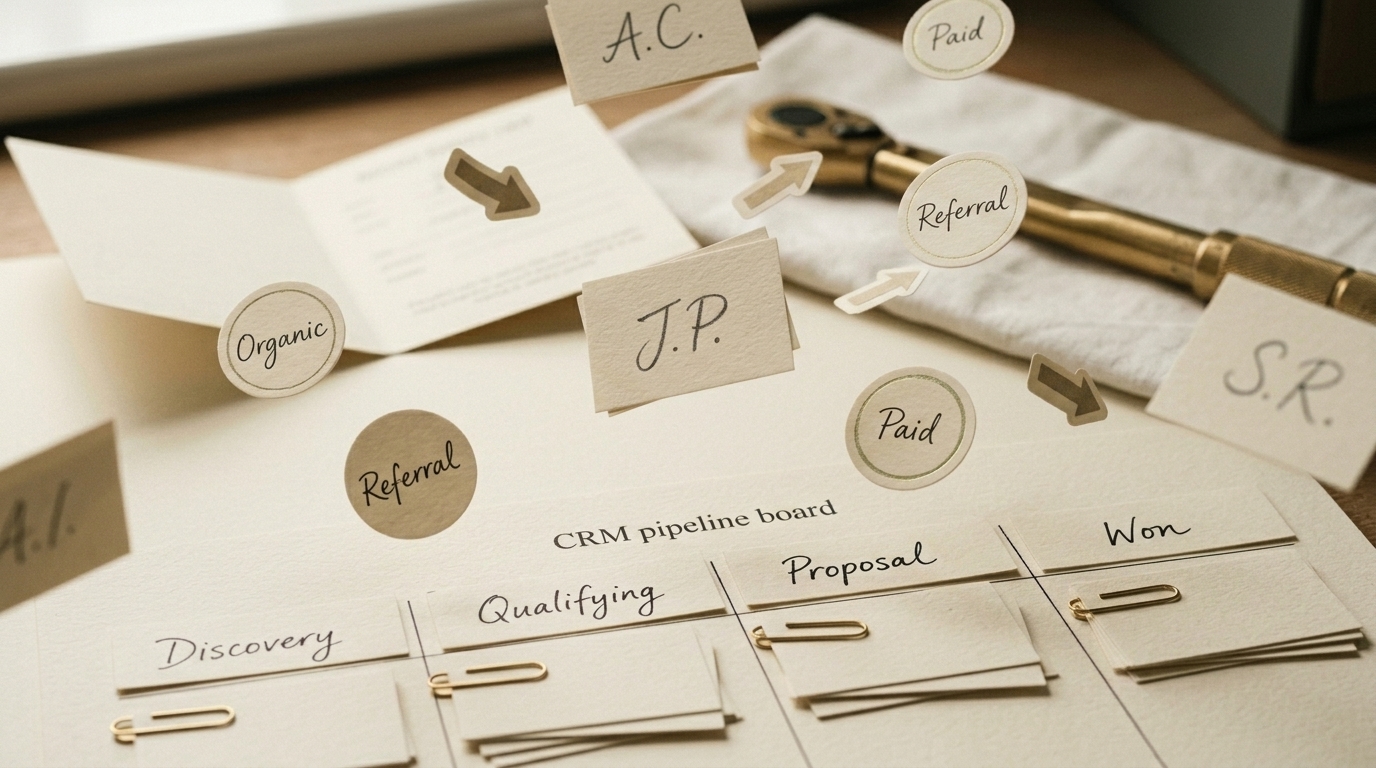
Server-side tracking spec and CRM pipeline definition
Tuned to Automotive — the version we ship to operators in this vertical.
Lead-magnet copy and landing-page brief
Tuned to Automotive — the version we ship to operators in this vertical.
Speed-to-lead automation rules (sub-5-minute response)
Tuned to Automotive — the version we ship to operators in this vertical.
Weekly volume + qualification dashboard
Tuned to Automotive — the version we ship to operators in this vertical.
Quarterly channel-mix review against actual revenue contribution
Tuned to Automotive — the version we ship to operators in this vertical.
SectionThe honest reframe most lead-gen agencies won't tell you
Generic lead-gen agencies sell dealers a Facebook lead-form headlined "Book a test drive" with three fields, no DMS integration, no finance pre-qualification, no part-exchange capture, and no idea which VRM the buyer was actually looking at on the forecourt. The leads land in a shared inbox. The sales manager forwards them to whoever's on the floor. The buyer has already messaged Auto Trader and walked into the franchise next door.
Automotive is a stock-specific, finance-attached, regulator-bounded category. The buyer enquiring on a 2022 Golf GTI does not want a phone call about "what kind of car you're looking for" — they want to know if that exact car is still on the lot, what the monthly payment is on PCP, and whether you'll take their Fiesta in part-exchange. FCA rules govern how that finance figure can be presented. The DMS knows the live stock; the lead form usually doesn't.
This playbook fixes the structure. Stock-specific routing is the conversion lever. FCA-compliant finance disclosure is the trust layer. DMS integration is the multiplier. Read it, run it yourself, or have us ship it on retainer — the canon is the same.
SectionThe eight-point audit we run on day one
Score your own funnel red / amber / green this week. Three or more reds means the foundation is broken — fix that before any new spend.
- Stock-specific lead routing (which VRM did the buyer enquire on) — Every enquiry should carry the VRM, stock number, model derivative, mileage and asking price into the CRM. A "general enquiry" form on a stock-detail page is a missed signal. The buyer is on that page for a reason; capture it and route the lead to the salesperson handling that vehicle.
- Finance pre-qualification capture with FCA-compliant disclosures — A representative example with APR, total cost of credit, fees, deposit, term and final balloon must appear at the point of enquiry, not buried in a PDF. Soft-search pre-qualification (no impact on credit file) lets the buyer see indicative monthly payment before walking in. ZutoFinance, iVendi and Codeweavers all integrate; the disclosure is the gate.
- Part-exchange valuation tool integrated into enquiry flow — Cap HPI, Glass's or Auto Trader Valuations embedded in the enquiry form, capturing reg, mileage and condition. Part-ex capture lifts test-drive booking by 25–40% because the buyer has already invested in the math.
- DMS integration (Pinnacle, Keyloop or Drivex) for live-stock-aware routing — Lead forms tied to live stock feed: if the car sells while the enquiry is in flight, the form auto-suggests three comparable alternatives in stock. Without DMS integration, the lead form is selling air.
- Service department lead architecture (MOT, service, tyres separated) — Service is a separate funnel from sales. MOT bookings, interim service, full service, tyre quotes and diagnostic enquiries each need their own form, with date/time selector tied to the workshop calendar. Mixed sales-and-service forms produce junk in both directions.
- Test-drive booking calendar with sales-team availability — Real-time slots, not "we'll call to arrange." Tied to the salesperson handling that VRM. Calendly, SimplyBook or the DMS-native calendar all work; the discipline is making the slot bookable in two clicks from the stock page.
- Review-request automation post-collection — SMS to the customer 48 hours after handover with a one-tap link to your Google Business Profile review URL. Compounds the local-pack ranking, builds the social proof on Auto Trader / Motors / Carwow, and seeds the next buyer's research.
- Offline conversion tracking — enquiry → test-drive → sale → finance attached — The full chain must feed back to Google Ads and Meta via offline conversions, with the finance flag and gross-profit value attached. Without this, the platforms optimise toward cheap form-fillers; with it, the algorithm bids on real metal-out-the-door customers within 30 days.
Three or more reds — fix the foundation before commissioning new ad spend.
SectionSix productised deliverables we ship per cycle
On a Foundation, Compound or Architect retainer, the same six outputs land in your portal each cycle. Industry-tuned, fixed scope, dated.
Stock-specific lead routing + DMS integration. Every enquiry tagged with VRM, stock number, derivative, mileage and asking price, pushed into Pinnacle, Keyloop or Drivex, then routed to the salesperson handling that vehicle. Live-stock feed wired to the form so sold cars trigger an automated comparable-alternatives email within 60 seconds. Time to first signal: 14 days. Owned by you.
Finance pre-qualification with FCA disclosures. Soft-search pre-qualification embedded at the enquiry stage via your existing finance platform (iVendi, Codeweavers, ZutoFinance or DMS-native). Representative example, APR, total cost of credit, fees, deposit, term and balloon all rendered correctly per the FCA's CONC sourcebook. The buyer sees an indicative monthly figure on PCP and HP before booking the test drive; the salesperson sees a credit-band signal at lead-arrival.
Part-exchange valuation capture. Cap HPI, Glass's or Auto Trader Valuations integrated into the enquiry flow. Reg + mileage + three condition questions = an indicative trade-in figure shown to the buyer pre-submit. Part-ex data flows into the CRM as a lead-quality field; sales team opens the conversation already knowing the buyer's existing-vehicle equity. Time to first signal: 21 days.
Service department lead architecture. Separate forms for MOT, interim service, full service, tyres, brakes and diagnostics, each with workshop calendar integration, technician assignment rules, and SMS reminders T-7 / T-1 / T-0. Service-department leads run on a different speed-to-lead clock (under 30 minutes is fine) but a higher conversion-to-booking discipline.
Test-drive booking calendar. Real-time bookable slots on every stock-detail page, tied to the salesperson handling that VRM. Two-click flow: pick a slot, confirm name + mobile + reg of part-ex. SMS confirmation to buyer with salesperson photo, ETA and forecourt postcode within 60 seconds; parallel notification to the salesperson with one-tap callback. Show-rate typically lifts 20–35% versus "we'll call to arrange."
Offline conversion tracking — enquiry → sale + finance. Server-side tagging through GA4 and a sGTM container, with offline conversion uploads to Google Ads and Meta covering enquiry, test-drive booked, test-drive completed, sold, finance attached and gross-profit value. The algorithm starts bidding on real metal customers within 30 days; junk-lead rate typically drops 30–50% inside 60 days.
SectionWhat to do this week
Three actions, ranked by leverage. Same first three steps we ship in week one of a Foundation retainer for a dealer or independent garage.
- Submit a test enquiry on a specific stock-detail page. Owner: founder or sales manager. Time: 30 minutes. Pick a real VRM. Fill in the enquiry form. Note whether the auto-response references that exact car, what the salesperson says when they call back, whether they know the VRM, and how long the whole loop took. Most dealers find the first response is generic and over an hour late.
- Audit your finance disclosures. Owner: founder or compliance officer. Time: 45 minutes. Open three stock-detail pages and the enquiry form. Confirm a representative example is visible — APR, total cost of credit, fees, deposit, term, balloon, total amount payable. If any field is missing, you have an FCA CONC issue, not just a marketing one. Fix this before scaling any paid spend.
- Decide DIY, DWY or DFY for the next 90 days. Owner: founder. See the three ways.
SectionFive questions car-dealer / garage operators ask us about lead-gen
What's a realistic CPL for automotive in 2026? Used-car enquiry CPL on Auto Trader and Motors typically sits at £18–£45, with franchise-new-car enquiry £30–£90 depending on brand and territory. Service-department CPL (MOT, interim) runs £6–£18 on Local Services Ads and Google Search. EV-specialist enquiry CPL £25–£60. The number that matters is cost-per-test-drive-booked and cost-per-metal-out — typically £80–£200 and £400–£900 respectively across used-car operators. CPL is a leading indicator; finance-attached gross-profit-per-sold-unit is the truth.
What's the impact of finance-attached penetration on the channel mix? Dealers with 60%+ finance penetration see materially lower effective CAC because the back-end commission compounds the front-end gross. Most independent dealers run 30–45% finance penetration and don't realise the lead-gen funnel is the lever — pre-qualification at the enquiry stage typically lifts finance penetration by 8–15 percentage points within a quarter. That's £150–£400 of additional gross per sold unit on PCP/HP commissions, before front-end profit.
How much does part-exchange capture move the needle? Part-ex data captured at enquiry lifts test-drive show-rate by 20–35% and final close rate by 10–18%. The mechanism is psychological: the buyer who has submitted reg + mileage has invested in the math and is committed. Add a Cap HPI or Glass's indicative valuation on the thank-you page and you've also told the buyer you'll honour their existing-vehicle equity, which removes the single biggest pre-test-drive objection.
How do we scale lead capture for the plate-change windows in March and September? Build the surge into the funnel architecture, not the team. Plate-change-window-specific landing pages launched 6–8 weeks ahead, with model-derivative quote-flow and registered-interest waitlists for delivery slots. Pre-warmed remarketing audiences from spring/autumn enquirers. Service-loaner availability gating to convert hesitant buyers. Most dealers double their March/September enquiry volume on flat ad spend by adding the architecture; the ones who only buy more clicks pay 1.5–2× the CPL.
Can we run this ourselves with the playbook + £750 audit? Yes — most dealers and garages can ship the form architecture, FCA disclosures and DMS routing rules in-house with a marketing manager + a developer half-week, especially if you're already running Pinnacle, Keyloop or Drivex with a finance platform like iVendi or Codeweavers. The £750 audit gets you a written red / amber / green scoring + named-owner / dated next steps + an FCA disclosure check on three stock pages. If you sign for DWY or DFY within 30 days, the audit fee credits against the first cycle.
SectionWhere to go from here
If you want this shipped end-to-end on a productised retainer, book a 30-minute discovery call. Tailored proposal in writing within two business days.
If you'd rather have a senior practitioner reviewing your team's work each week, the coaching plans start at £750/month with rolling cycles and walk-away rights. If you have a hard deadline — plate-change-window prep for March or September, a new-franchise launch, an EV-specialist site rebuild — the two-week embedded sprint lands a senior practitioner inside your tools and DMS for ten working days at £3,000 fixed.
Or run it yourself. Eight-point audit + one deliverable a month + twice-quarterly office hours.
Get Lead Generation for Automotive.
A focused, no-fluff playbook covering the audit, the deliverables, the success signals and the cadence we use when we run this combination for clients. Automotive-specific from the first page to the last.
No spam. One playbook, one follow-up email a week later asking what landed and what didn’t. Unsubscribe in one click.
Where the playbook ends and the engagement begins.
The framework, free
- The eight-point audit baseline so you can score your own site this week
- The six productised deliverables we ship per cycle, named and explained
- The 30/60/90 fix roadmap so you can plan internal capacity
- The three-way model (DIY / DWY / DFY) and price bands
- The success metrics we track and the time-to-signal canon
- The industry-specific regulators, sub-verticals and trust signals
What requires the call
- Named-client case studies with revenue numbers (NDA-protected)
- Our internal tooling stack and platform vendors (trade-secret)
- The proprietary scoring rubric we use to triage problems
- Specific commercial terms beyond published price bands
- Direct introductions to our partner network
- The post-engagement playbook revisions we ship per cycle
Adjacent combinations operators in this vertical also read.
Lead Generation for Personal Brands & Creators
A focused playbook for Personal Brands & Creators operators running Lead Generation.
Open the playbook → PLAYBOOKLead Generation for Real Estate & Property
A focused playbook for Real Estate & Property operators running Lead Generation.
Open the playbook → PLAYBOOKEmail Marketing for Automotive
A focused playbook for Automotive operators running Email Marketing.
Open the playbook → PLAYBOOKSEO & Organic Growth for Automotive
A focused playbook for Automotive operators running SEO & Organic Growth.
Open the playbook →Start your Lead Generation for Automotive programme.
Thirty-minute discovery call, free, no commitment. We’ll send a tailored band before the call and a written proposal within two business days.