
Lead Generation for Beauty & Personal Care — The Practitioner’s Playbook.
A focused playbook for Beauty & Personal Care operators running Lead Generation. CAP / ASA code constrains aesthetics advertising more than most operators realise, and one breach can cost a year of media budget. Salon, clinic, retail and training each have their own funnel economics — combining them dilutes everything.
Lead Generation for Beauty & Personal Care is its own discipline.
Six things this playbook covers, end to end.
Funnel architecture from impression to closed-won
Tuned to Beauty & Personal Care — the version we ship to operators in this vertical.
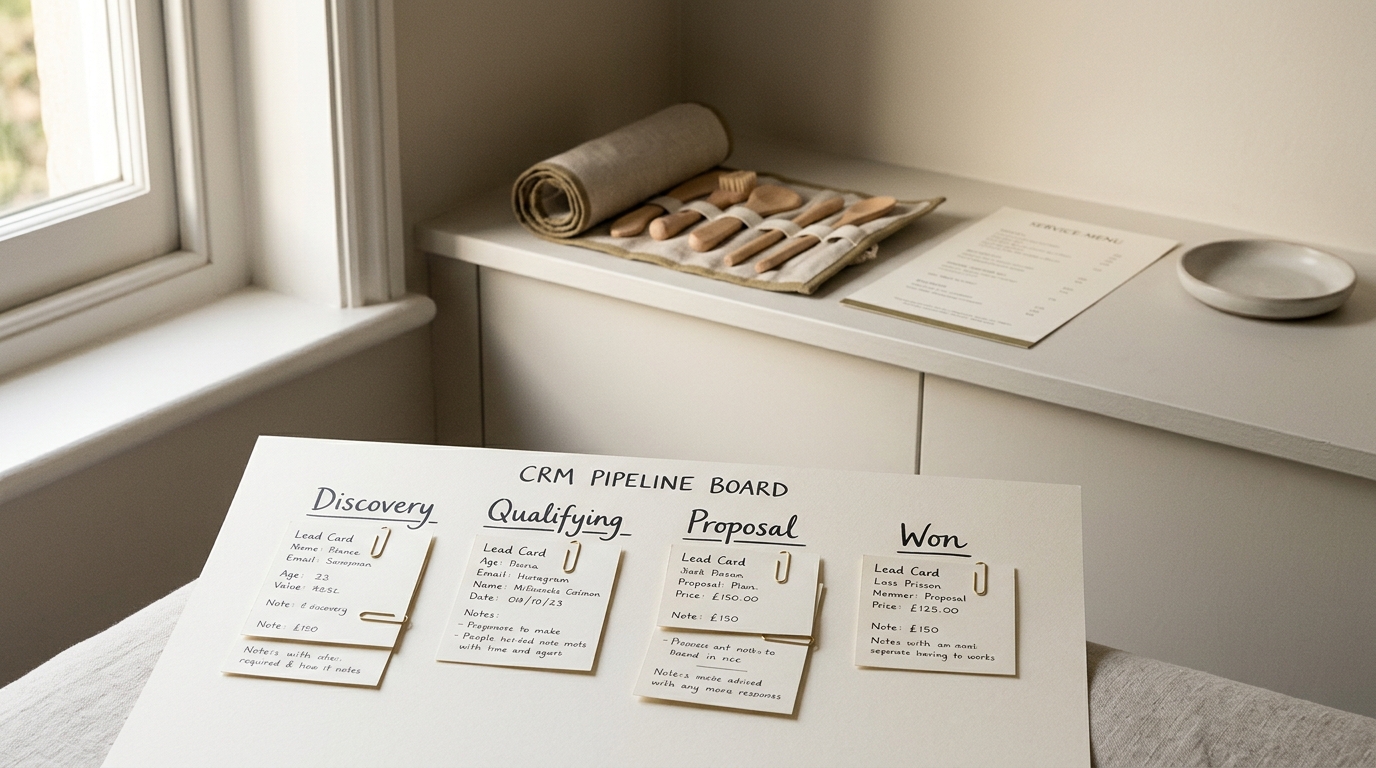
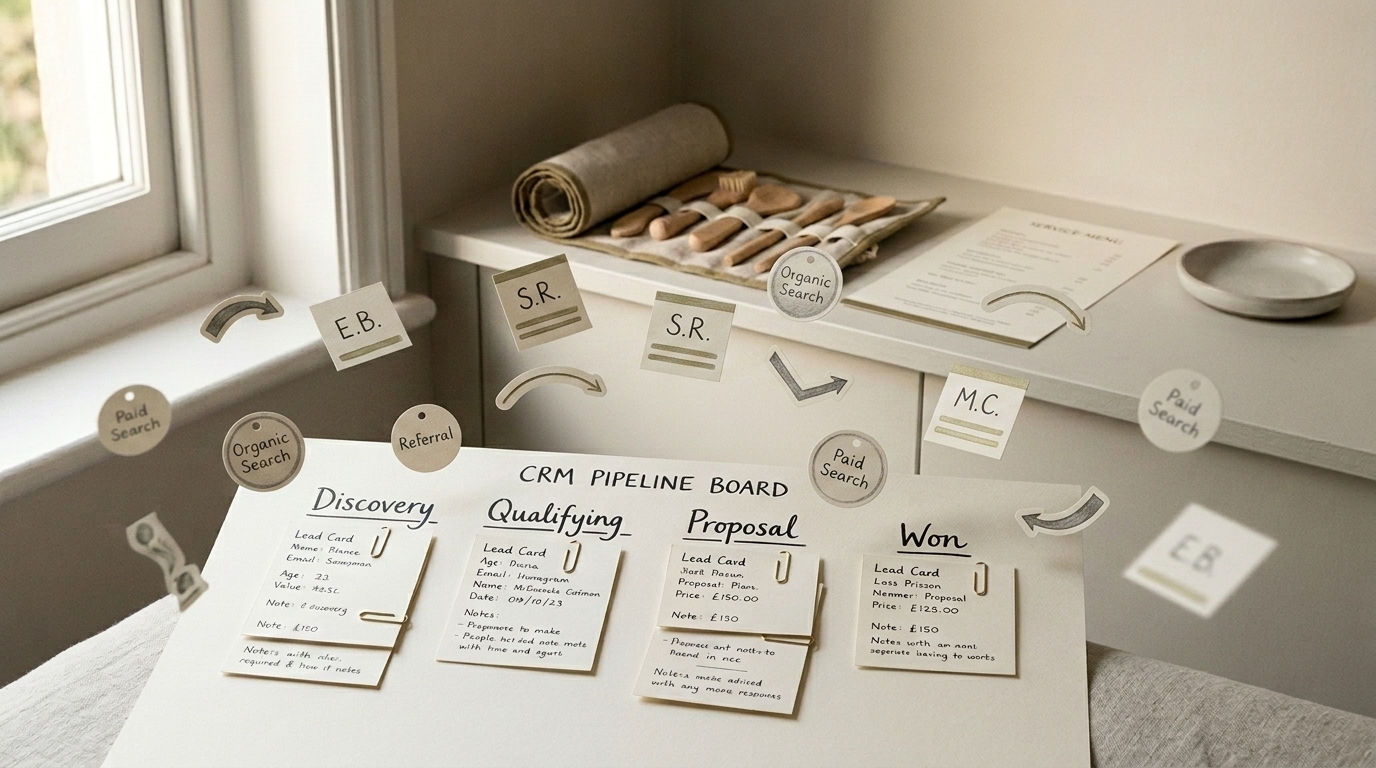
Server-side tracking spec and CRM pipeline definition
Tuned to Beauty & Personal Care — the version we ship to operators in this vertical.
Lead-magnet copy and landing-page brief
Tuned to Beauty & Personal Care — the version we ship to operators in this vertical.
Speed-to-lead automation rules (sub-5-minute response)
Tuned to Beauty & Personal Care — the version we ship to operators in this vertical.
Weekly volume + qualification dashboard
Tuned to Beauty & Personal Care — the version we ship to operators in this vertical.
Quarterly channel-mix review against actual revenue contribution
Tuned to Beauty & Personal Care — the version we ship to operators in this vertical.
SectionThe honest reframe most lead-gen agencies won't tell you
Generic lead-gen agencies sell salons, brow bars and aesthetic clinics a Facebook lead-form for "free consultations" with copy that promises results no regulator will let you put on a billboard. The form has three fields, the routing is "email when filled in," the booking link drops the buyer onto a Fresha or Treatwell homepage instead of a deep-linked stylist + service slot, and nobody is tracking whether the lead actually showed up. Then the agency reports "300 leads this month" while the chair sits empty on a Wednesday afternoon.
Beauty buyers are not waiting around. The hair client is comparing four salons inside Treatwell while the kettle boils; the aesthetic client is reading Save Face register entries before they part with £350 for filler. A lead form that doesn't deep-link to the right stylist on the right service at a real available time is a lead form that produces leakage between enquiry and booked chair. A salon with no deposit policy is a salon training its no-show rate to 20%+. A clinic running ASA-non-compliant before/after copy is one complaint away from an upheld ruling.
This playbook fixes the structure. ASA-compliant copy is the foundation. Deep-linked booking is the conversion lever. Deposits + SMS reminders + offline conversion tracking are the moat. Read it, run it yourself, or have us ship it on retainer — the canon is the same.
SectionThe eight-point audit we run on day one
Score your own funnel red / amber / green this week. Three or more reds means the foundation is broken — fix that before any new spend.
- ASA-compliant copy on aesthetic claims — Botulinum toxin (Botox is a brand name, not a generic), prescription-only medicines, dermal-filler outcomes and weight-loss claims are all inside ASA + MHRA scope. "Removes wrinkles," "guaranteed results," before/after pairs without disclaimers, and POM-product brand names on social are the four most common upheld-complaint patterns. Save Face publishes its register; Treatwell and Fresha both moderate listing copy. Get this wrong and the cost is a public ruling, not a slap on the wrist.
- Deep-linked Fresha / Treatwell / Booksy / Phorest booking, not "book now" then drop-off — Most salons run a paid ad to a landing page with a "Book now" button that opens the Fresha homepage. The buyer then has to find the salon, find the service, find a stylist, find a time. Drop-off at this step is typically 50-70%. The fix is a deep link straight to the service + stylist + earliest-available slot. A 5-minute platform-side change usually doubles conversion.
- Stylist-level routing on the booking flow — Senior stylist vs junior stylist vs apprentice is a 2-3× price difference and a 2-3× margin difference. New clients funnelled to the cheapest slot are the lowest-LTV cohort you'll book. Routing the high-intent enquiry (referral, returning lapsed, upsell-tagged) to a senior stylist is a margin lever bigger than any ad-spend optimisation.
- Deposit / no-show reduction tactic — A 10-25% deposit at booking cuts no-show rate by 40-60% across the category. Industry baseline is 15-25% no-show without deposits, dropping to 4-10% with. Fresha, Treatwell, Booksy and Phorest all support deposit collection at booking. Salons that refuse to take deposits because "it'll put clients off" are choosing a 20% empty-chair rate over a 5% conversion-friction rate. The maths doesn't favour them.
- Review-request automation post-appointment — SMS or email triggered 24-48 hours after the appointment with a one-tap link to the Google review URL. Compounds the local-pack ranking, future buyer-side conversion at the moment of decision, and Treatwell / Fresha listing visibility. Target 4-8 reviews/month per location, 60%+ owner-response rate on every review.
- SMS reminder 24h pre-appointment — The single highest-leverage no-show automation outside of deposits. SMS at booking + SMS at 24h prior + SMS at 2h prior is the canon for new clients. Reduces no-show rate by a further 20-30% on top of any deposit policy.
- First-visit consultation flow vs returning-customer flow separation — A first-time aesthetic client needs a consultation, a patch test, a medical questionnaire and a cooling-off period. A returning client needs a one-tap re-book on the same treatment. Mixing these two on one booking flow loses the new client (too much friction) and the loyal client (too many fields). Separate flows + separate routing is a 30-minute platform setting with a measurable conversion lift.
- Offline conversion tracking enquiry → booked → showed → re-booked — Without this, paid platforms optimise toward the cheapest "form submission" or "click-to-book" (junk). Send the booked-and-showed status back to Google + Meta as an offline conversion. The algorithm shifts to bidding on real customers within 30-45 days. Re-booking rate at 90 days is the truth metric for client quality; CPL is the leading indicator.
Three or more reds — fix the foundation before commissioning new ad spend.
SectionSix productised deliverables we ship per cycle
On a Foundation, Compound or Architect retainer, the same six outputs land in your portal each cycle. Industry-tuned, fixed scope, dated.
ASA-compliant ad-copy + landing pages. Industry-vetted ad-copy variants for each treatment line, scrubbed against current ASA + CAP guidance and the Save Face / NHBF / BABTAC compliance positions. Landing pages with on-brand testimonial structure (real-customer permission templates included), before/after disclaimer language, POM-medicine compliance (no brand names on filler / botulinum toxin ads), and a quote / consultation request flow that gates aesthetic enquiries to the medical questionnaire. Time to first signal: 14 days. Owned by you.
Deep-linked booking integration. Every paid ad, every organic post, every email CTA, every Google Business Profile call-to-action lands on a deep link to a specific service + stylist + earliest-available slot inside Fresha / Treatwell / Booksy / Phorest. Built once, reused everywhere. The single highest-leverage platform fix in this category. Time to first signal: same week.
Stylist-level routing on the booking flow. Routing rules that send referral leads to senior stylists, returning lapsed clients to their preferred stylist, and new low-intent enquiries to the right tier on price and capacity. Includes a margin-aware booking calendar — peak slots reserved for higher-margin services, off-peak filled by lower-margin overflow. Built natively in Fresha / Treatwell or via a thin layer on top of Phorest.
Deposit + SMS-reminder no-show reduction. Deposit policy live across all bookable services (10-25% by service-line risk profile), SMS reminder cadence at booking + 24h + 2h, automated rebooking + refund flow on cancellation inside the cooling-off window, and a reporting layer that shows no-show rate trending by service-line, stylist and source. Industry-standard tools — your booking platform plus Twilio or equivalent. Typical no-show reduction 40-60% in cycle one.
Review-request automation post-appointment. SMS or email triggered 24-48h after appointment, one-tap Google review link, fallback to Treatwell / Fresha review prompt for clients who don't have a Google account active. Owner-response template library for the four most common review patterns. Target 4-8 reviews/month per location. Compounds local-pack ranking and platform-listing visibility. Time to first signal: 21 days.
Offline conversion tracking booked → showed → repeat. GA4 + sGTM container shipping conversion data + status (booked, showed, re-booked, no-show) back to Google Ads and Meta. Re-booking rate at 90 days is the truth metric. The algorithm shifts to bidding on real, repeat-spending clients within 30-45 days; junk-lead rate typically drops 30-50% in cycle two.
SectionWhat to do this week
Three actions, ranked by leverage. Same first three steps we ship in week one of a Foundation retainer for a salon, brow bar, spa or aesthetic clinic.
- Test your own booking flow as a new client. Owner: founder or salon manager. Time: 20 minutes. Click your most-recent paid ad or your Instagram bio link. Time how many taps it takes to reach a confirmed booking. If it's more than three, the deep-link fix is your highest-leverage change. Most operators discover their booking funnel takes seven or eight taps and is invisibly leaking 50%+ of clicks.
- Pull your no-show rate for the last 60 days. Owner: salon manager. Time: 30 minutes. Open Fresha / Treatwell / Booksy / Phorest. Filter by status. Calculate no-shows ÷ total bookings. If it's over 10%, you're without a deposit policy or your deposit policy isn't enforced. Either fix is a same-week change with a measurable margin impact.
- Decide DIY, DWY or DFY for the next 90 days. Owner: founder. See the three ways.
SectionFive questions salon / aesthetic operators ask us about lead-gen
What's a realistic CPL target for beauty in 2026? Cost-per-enquiry sits at £8–£25 for hair, £10–£30 for beauty + brows + lashes, £25–£100 for aesthetic / injectable / advanced cosmetic. What matters more is cost-per-booked-and-showed appointment — typically £18–£45 hair, £20–£60 beauty, £55–£200 aesthetics. CPL is a leading indicator; CAC and 90-day re-booking rate are the truth.
How real is the ASA risk on aesthetic ad copy? Real. The ASA upheld 1,000+ rulings in 2024 across the cosmetic / aesthetic category, with the most common patterns being POM-product brand names (Botox, Profhilo, Juvederm) on Meta ads, before/after pairs without disclaimers, and outcome guarantees. An upheld ruling is published, indexed by Google, and stays on your record. Save Face register membership + ASA-compliant copy is not optional for serious clinics — it's the licence to advertise at all.
Do deposits actually lift bookings, or do they put clients off? They lift booked-and-showed appointments by 30-50% net, on industry data. The maths: if your no-show rate is 20% without deposits and you charge a 15% deposit, your no-show rate typically drops to 6-8%, which more than compensates for the small percentage of price-sensitive clients who refuse to deposit. Deposit acceptance rate across the category sits at 85-92% — most clients accept without friction, especially when the deposit credits against the appointment.
What deposit percentage is right for our service mix? 10-15% for hair + barbers + standard beauty (low-cost, high-volume, low no-show downside). 20-25% for aesthetics + advanced cosmetic + high-cost colour services (high-cost, low-volume, high no-show downside). 100% pre-payment for short slots (15-30 minute brow / lash / nail top-ups) where the no-show literally cannot be filled. Tier the policy by service-line, not blanket-applied — clients tolerate the policy when it's proportionate.
Can we run this ourselves with the playbook + £750 audit? Yes — most of the audit-and-fix list above is achievable in-house if you have a salon manager + a half-week with a developer or an automation contractor. Deep-linked booking is a 30-minute Fresha / Treatwell setting. Deposit + SMS reminder is a same-day platform configuration. ASA-compliant copy is a checklist + a couple of hours of rewriting. The £750 audit gets you a written red / amber / green scoring + named-owner / dated next steps. If you sign for DWY or DFY within 30 days, the audit fee credits against the first cycle.
SectionWhere to go from here
If you want this shipped end-to-end on a productised retainer, book a 30-minute discovery call. Tailored proposal in writing within two business days.
If you'd rather have a senior practitioner reviewing your team's work each week, the coaching plans start at £750/month with rolling cycles and walk-away rights. If you have a hard deadline (a new-location launch, a pre-summer-season push, a pre-Christmas booking-window blitz, an ASA compliance rebuild after a complaint), the two-week embedded sprint lands a senior practitioner inside your tools for ten working days at £3,000 fixed.
Or run it yourself. Eight-point audit + one deliverable a month + twice-quarterly office hours.
Get Lead Generation for Beauty & Personal Care.
A focused, no-fluff playbook covering the audit, the deliverables, the success signals and the cadence we use when we run this combination for clients. Beauty & Personal Care-specific from the first page to the last.
No spam. One playbook, one follow-up email a week later asking what landed and what didn’t. Unsubscribe in one click.
Where the playbook ends and the engagement begins.
The framework, free
- The eight-point audit baseline so you can score your own site this week
- The six productised deliverables we ship per cycle, named and explained
- The 30/60/90 fix roadmap so you can plan internal capacity
- The three-way model (DIY / DWY / DFY) and price bands
- The success metrics we track and the time-to-signal canon
- The industry-specific regulators, sub-verticals and trust signals
What requires the call
- Named-client case studies with revenue numbers (NDA-protected)
- Our internal tooling stack and platform vendors (trade-secret)
- The proprietary scoring rubric we use to triage problems
- Specific commercial terms beyond published price bands
- Direct introductions to our partner network
- The post-engagement playbook revisions we ship per cycle
Adjacent combinations operators in this vertical also read.
Lead Generation for Automotive
A focused playbook for Automotive operators running Lead Generation.
Open the playbook → PLAYBOOKLead Generation for Trades & Home Services
A focused playbook for Trades & Home Services operators running Lead Generation.
Open the playbook → PLAYBOOKBrand & Design for Beauty & Personal Care
A focused playbook for Beauty & Personal Care operators running Brand & Design.
Open the playbook → PLAYBOOKPaid Advertising for Beauty & Personal Care
A focused playbook for Beauty & Personal Care operators running Paid Advertising.
Open the playbook →Start your Lead Generation for Beauty & Personal Care programme.
Thirty-minute discovery call, free, no commitment. We’ll send a tailored band before the call and a written proposal within two business days.