

Lead Generation for Personal Brands & Creators — The Practitioner’s Playbook.
A focused playbook for Personal Brands & Creators operators running Lead Generation. A satellite of social channels that monetises nothing is a hobby, not a brand. Owned domain + email list is what compounds. Sponsorship, product, course and audience monetisation each have their own playbook, but operators usually run only one.
Lead Generation for Personal Brands & Creators is its own discipline.
Six things this playbook covers, end to end.
Funnel architecture from impression to closed-won
Tuned to Personal Brands & Creators — the version we ship to operators in this vertical.
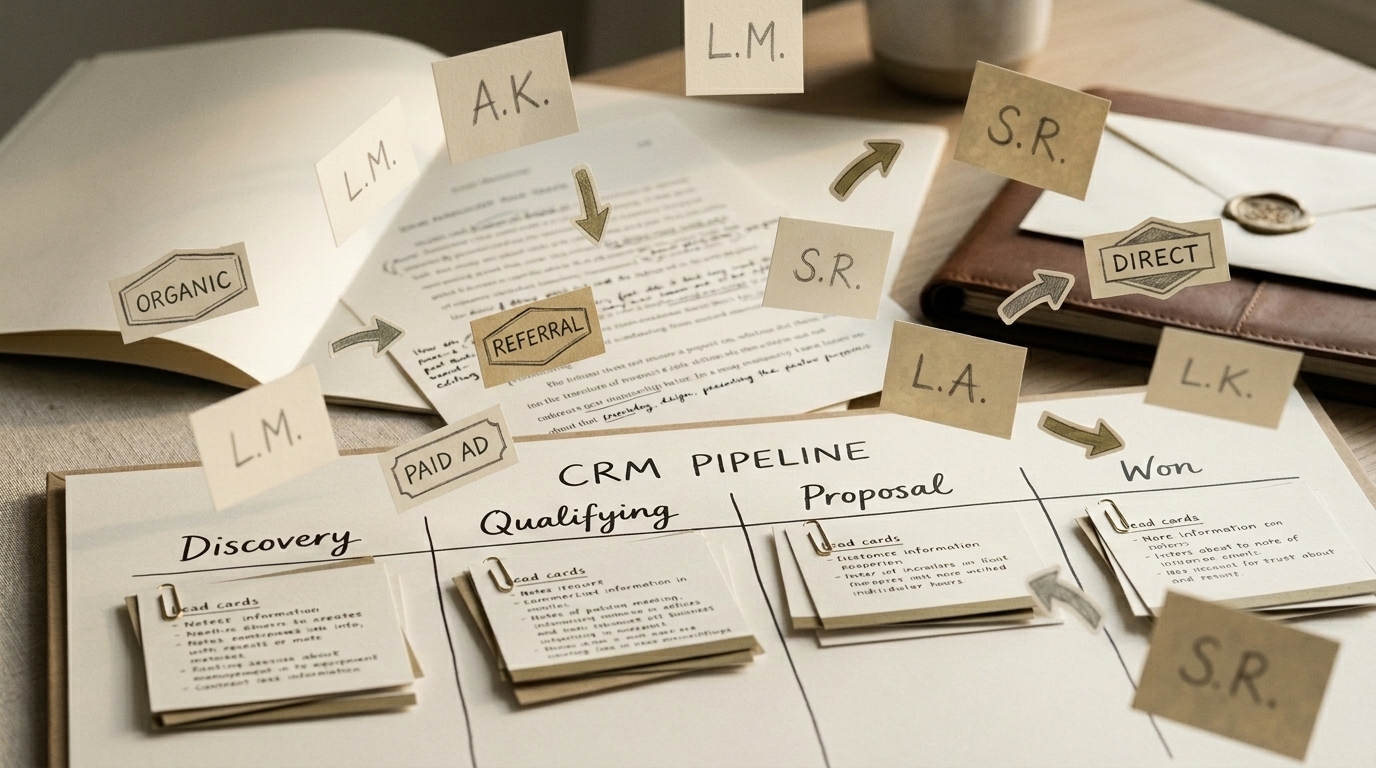
Server-side tracking spec and CRM pipeline definition
Tuned to Personal Brands & Creators — the version we ship to operators in this vertical.
Lead-magnet copy and landing-page brief
Tuned to Personal Brands & Creators — the version we ship to operators in this vertical.
Speed-to-lead automation rules (sub-5-minute response)
Tuned to Personal Brands & Creators — the version we ship to operators in this vertical.
Weekly volume + qualification dashboard
Tuned to Personal Brands & Creators — the version we ship to operators in this vertical.
Quarterly channel-mix review against actual revenue contribution
Tuned to Personal Brands & Creators — the version we ship to operators in this vertical.
SectionThe honest reframe most lead-gen agencies won't tell you
Generic lead-gen agencies sell coaches, authors, course creators and consultants-as-product the same Meta-ads-to-low-ticket-course funnel they've been recycling since 2019. £29 tripwire, upsell to a £997 course, hope it pays back. Then the operator wonders why their high-ticket coaching diary is empty, the email list is full of refund-chasers, and the cost-per-acquired-customer on the £5,000 mastermind is invisible because nothing tracks past the tripwire.
Personal brands are not low-ticket course businesses. The economics work on a small number of high-quality discovery calls converting into £3,000–£25,000 coaching, mastermind, advisory or speaking engagements. The list-build is a nurture funnel, not the destination. Podcast and YouTube listeners convert at 5–10× the rate of cold paid-ad traffic. ASA disclosure rules apply the moment a creator endorses a product or runs an affiliate. None of that is in the standard agency playbook.
This playbook fixes the structure. Application-form gating is the lead filter. Podcast / YouTube CTAs are the highest-quality channel. Newsletter is the nurture, not the conversion. Read it, run it yourself, or have us ship it on retainer — the canon is the same.
SectionThe eight-point audit we run on day one
Score your own funnel red / amber / green this week. Three or more reds means the foundation is broken — fix that before any new spend.
- Discovery-call application form (not just "book a call") — Open-calendar links produce tyre-kickers and £15-budget hopefuls. A 6–10-field application form (current revenue or income, problem they're solving, budget range, timeline, what they've already tried) cuts unqualified bookings by 60–80% and lifts close-rate on the calls that do happen by 2–3×. The form is the filter; the calendar is the reward.
- Calendar deep-link with applicant qualification gate — Application form first, calendar second. Conditional logic on the form: applicants below the budget floor or outside your ideal-client criteria get a "you'd be better served by [signature course / waitlist / nothing]" page, not a calendar slot. Tools: Tally / Typeform → Calendly / SavvyCal / Cal.com routing forms. Stops the discovery-call diary becoming a sales-prevention exercise.
- Podcast / YouTube CTA architecture — For coaches, creators and authors with an audio or video presence, this is the highest-quality lead source you have. CPL-equivalent on a podcast call-to-action runs £0–£15 (your time + production); discovery-call close-rate on podcast leads typically sits at 30–45% vs 8–15% on cold paid-ad leads. Show-notes link, mid-roll CTA, end-screen card on YouTube, pinned comment, episode-specific landing page — all underbuilt in 80% of creator funnels.
- Substack / Beehiiv / ConvertKit / Kajabi newsletter as nurture funnel — Not as the conversion engine. The newsletter's job is to keep warm prospects engaged for the 30–180 days between first touch and discovery call. Weekly cadence, signature-framework content, periodic soft CTAs to the application form. Open-rate target: 35%+. Click-to-application-form conversion: 0.5–2% per send is healthy on a quality list.
- ASA disclosure on affiliate / sponsorship content — UK Advertising Standards Authority requires #ad / #gifted / paid-partnership disclosure on creator endorsements, including affiliate links, gifted products and brand-paid content. CAP Code compliance is non-optional and the ASA publishes named-individual rulings monthly. Audit every page, post, podcast description, YouTube video and email — disclosure must be upfront, prominent, and unambiguous.
- Multi-product sequencing (low-ticket → mid → high-ticket discovery) — A signature framework needs price-laddered offers: free lead magnet → £29–£99 self-paced product → £299–£997 group programme → £3,000+ coaching / mastermind / advisory. Each step qualifies the next; the high-ticket call only goes to people who've already paid you something. Cuts cost-per-high-ticket-customer by 40–70% versus cold-traffic-to-discovery-call funnels.
- Offline conversion tracking newsletter → discovery → contracted — Without server-side tracking + offline conversion uploads, paid platforms optimise toward the cheapest "newsletter signup" (low-quality). Send the contracted-engagement event back via Google's offline conversion API + Meta CAPI with revenue values; the algorithm starts bidding on real high-ticket buyers within 30–60 days.
- Refund / cancellation policy displayed clearly — UK Consumer Contracts Regulations 2013 give buyers 14-day cancellation rights on most digital and service purchases unless explicitly waived (and the waiver itself has rules). Hidden or absent refund policies invite chargebacks and ASA complaints. Display T&Cs at checkout, in the welcome email, and in the application-form footer. Reduces refund rate, lifts trust, and shortens the sales cycle.
Three or more reds — fix the foundation before commissioning new ad spend.
SectionSix productised deliverables we ship per cycle
On a Foundation, Compound or Architect retainer, the same six outputs land in your portal each cycle. Industry-tuned, fixed scope, dated.
Discovery-call application form. A 6–10-field form built in Tally / Typeform / native Kajabi, with conditional logic that gates calendar access by budget, timeline and ideal-client fit. Applicants below threshold get routed to your signature course / waitlist / a clean "not the right fit" page rather than wasting a discovery slot. Embedded on landing pages, podcast show-notes pages, YouTube end-screens, and the high-ticket sales page. Time to first signal: 7 days. Owned by you.
Calendar with applicant qualification gate. Calendly / SavvyCal / Cal.com configured with hidden routing logic: only applicants who've completed the form and meet the criteria see live availability. Pre-call questionnaire reminders 24h and 1h before the booking, automatic reschedule + no-show recovery sequences. Eliminates the open-calendar tyre-kicker problem. Time to first signal: same week.
Podcast / YouTube CTA architecture. Episode-specific landing pages, pinned-comment CTAs, mid-roll and end-roll scripted call-outs, show-notes link placement, end-screen YouTube cards, dedicated pixel-tracked subdomain or path so podcast / YouTube traffic is attributable in your analytics. The creator-economy lead source most operators leave on the table. Time to first signal: 14 days.
Newsletter nurture funnel. Substack / Beehiiv / ConvertKit / Kajabi sequence + weekly broadcast cadence. Welcome series (5–7 emails) with signature-framework content and a soft CTA to the application form on email 4 or 5. Weekly newsletter template in your tone, with periodic application-form CTAs and lower-ticket offer placements. ASA-compliant disclosure on any affiliate or sponsored mentions.
Multi-product sequencing. Architecture and tracking for a price-laddered offer stack: lead magnet → low-ticket → mid-ticket → high-ticket discovery. Conditional logic so each customer sees the next-rung offer at the right moment, not all four at once. Cuts cost-per-high-ticket-customer 40–70% versus cold-to-discovery-call funnels. Time to first signal: 21 days.
Offline conversion tracking newsletter → contracted. GA4 + sGTM container shipping conversion data + revenue values back to Google Ads and Meta. Discovery-call-booked, discovery-call-completed, contracted-engagement, and revenue-value events flowing back via offline conversion API + Meta CAPI. The algorithm bids on real customers, not list-builders. Junk-lead rate typically drops 40–60% within 90 days as the algorithm learns.
SectionWhat to do this week
Three actions, ranked by leverage. Same first three steps we ship in week one of a Foundation retainer for a personal-brand operator.
- Replace your open calendar link with an application form. Owner: founder. Time: 2 hours. Build a 6–10-field Tally / Typeform / native form. Add conditional logic that gates the calendar by budget and fit. Update every CTA on the site, in show-notes, and in your email signature to point at the form, not the calendar. Single highest-leverage change in the personal-brand category.
- Audit your podcast / YouTube CTA architecture. Owner: founder or producer. Time: 1 hour. Open the last five episodes / videos. Count the CTAs in the show-notes, pinned comment, end-screen, mid-roll, and description. If it's three or fewer per episode, you're leaking your highest-quality lead source. Add an episode-specific landing page and a pixel-tracked path within the same week.
- Decide DIY, DWY or DFY for the next 90 days. Owner: founder. See the three ways.
SectionFive questions coach / author / creator operators ask us about lead-gen
Discovery-call application form vs open booking — what's the actual lift? On comparable funnels we've seen, application-gated booking lifts close-rate on completed calls from 8–15% to 25–45% and cuts no-show rate from ~30% to under 10%. Volume of calls drops 50–70%, but volume of contracted clients rises 30–80%. The economics are unambiguous if your offer is £3,000+. Below £1,000 ticket the open calendar can still work; above it, the form pays for itself in week one.
Podcast / YouTube vs paid-ad lead quality — is it really 5–10× better? Yes, and it's measurable. Podcast and YouTube listeners arrive having consumed 30–60+ minutes of your thinking; paid-ad clickers have seen one creative for three seconds. Discovery-call close-rate on podcast leads typically runs 30–45% vs 8–15% on cold paid leads. CPL-equivalent on a podcast CTA is £0–£15 (your time + production); paid discovery-call CPL in the personal-brand category sits at £30–£300 depending on price-point. The gap is the case for shifting budget from paid to owned-channel production.
What's the realistic newsletter conversion math at our list size? A healthy 5,000-subscriber newsletter at 35% open-rate and 0.5–2% click-to-application conversion produces 9–35 application-form starts per send, of which 30–60% complete and 20–40% qualify for a discovery call. So 1–8 qualified discovery calls per send, with weekly cadence. Across a quarter, that's 13–100 calls — typically 3–25 contracted engagements at personal-brand price-points. Newsletter list-build CPL of £1–£8 makes the maths work even without paid amplification.
ASA on creator endorsements — what actually breaks the rules? The CAP Code requires upfront, prominent, unambiguous disclosure on any commercial relationship — affiliate links, gifted products, paid partnerships, your own paid promotions. #ad at the start of a caption (not buried in hashtags), spoken disclosure at the start of a podcast segment, on-screen text in YouTube videos. The ASA publishes named-individual rulings monthly and the rulings are search-indexed forever. Audit every channel before next post; retrofit disclosure where missing.
Can we run this ourselves with the playbook + £750 audit? Yes — most of the audit-and-fix list above is achievable in-house if you have a content manager / producer + half a developer-week for tracking. The £750 audit gets you a written red / amber / green scoring + named-owner / dated next steps across all eight points. If you sign for DWY or DFY within 30 days, the audit fee credits against the first cycle.
SectionWhere to go from here
If you want this shipped end-to-end on a productised retainer, book a 30-minute discovery call. Tailored proposal in writing within two business days.
If you'd rather have a senior practitioner reviewing your team's work each week, the coaching plans start at £750/month with rolling cycles and walk-away rights. If you have a hard deadline (a book launch, a signature-framework rollout, a course relaunch, a season of podcast sponsorship campaigns), the two-week embedded sprint lands a senior practitioner inside your tools for ten working days at £3,000 fixed.
Or run it yourself. Eight-point audit + one deliverable a month + twice-quarterly office hours.
Get Lead Generation for Personal Brands & Creators.
A focused, no-fluff playbook covering the audit, the deliverables, the success signals and the cadence we use when we run this combination for clients. Personal Brands & Creators-specific from the first page to the last.
No spam. One playbook, one follow-up email a week later asking what landed and what didn’t. Unsubscribe in one click.
Where the playbook ends and the engagement begins.
The framework, free
- The eight-point audit baseline so you can score your own site this week
- The six productised deliverables we ship per cycle, named and explained
- The 30/60/90 fix roadmap so you can plan internal capacity
- The three-way model (DIY / DWY / DFY) and price bands
- The success metrics we track and the time-to-signal canon
- The industry-specific regulators, sub-verticals and trust signals
What requires the call
- Named-client case studies with revenue numbers (NDA-protected)
- Our internal tooling stack and platform vendors (trade-secret)
- The proprietary scoring rubric we use to triage problems
- Specific commercial terms beyond published price bands
- Direct introductions to our partner network
- The post-engagement playbook revisions we ship per cycle
Adjacent combinations operators in this vertical also read.
Lead Generation for Beauty & Personal Care
A focused playbook for Beauty & Personal Care operators running Lead Generation.
Open the playbook → PLAYBOOKLead Generation for Combat Sports & Fitness
A focused playbook for Combat Sports & Fitness operators running Lead Generation.
Open the playbook → PLAYBOOKAutomation & CRM for Personal Brands & Creators
A focused playbook for Personal Brands & Creators operators running Automation & CRM.
Open the playbook → PLAYBOOKStrategy & Consultancy for Personal Brands & Creators
A focused playbook for Personal Brands & Creators operators running Strategy & Consultancy.
Open the playbook →Start your Lead Generation for Personal Brands & Creators programme.
Thirty-minute discovery call, free, no commitment. We’ll send a tailored band before the call and a written proposal within two business days.